Registering with Your Embassy in Spain: Why It Helps
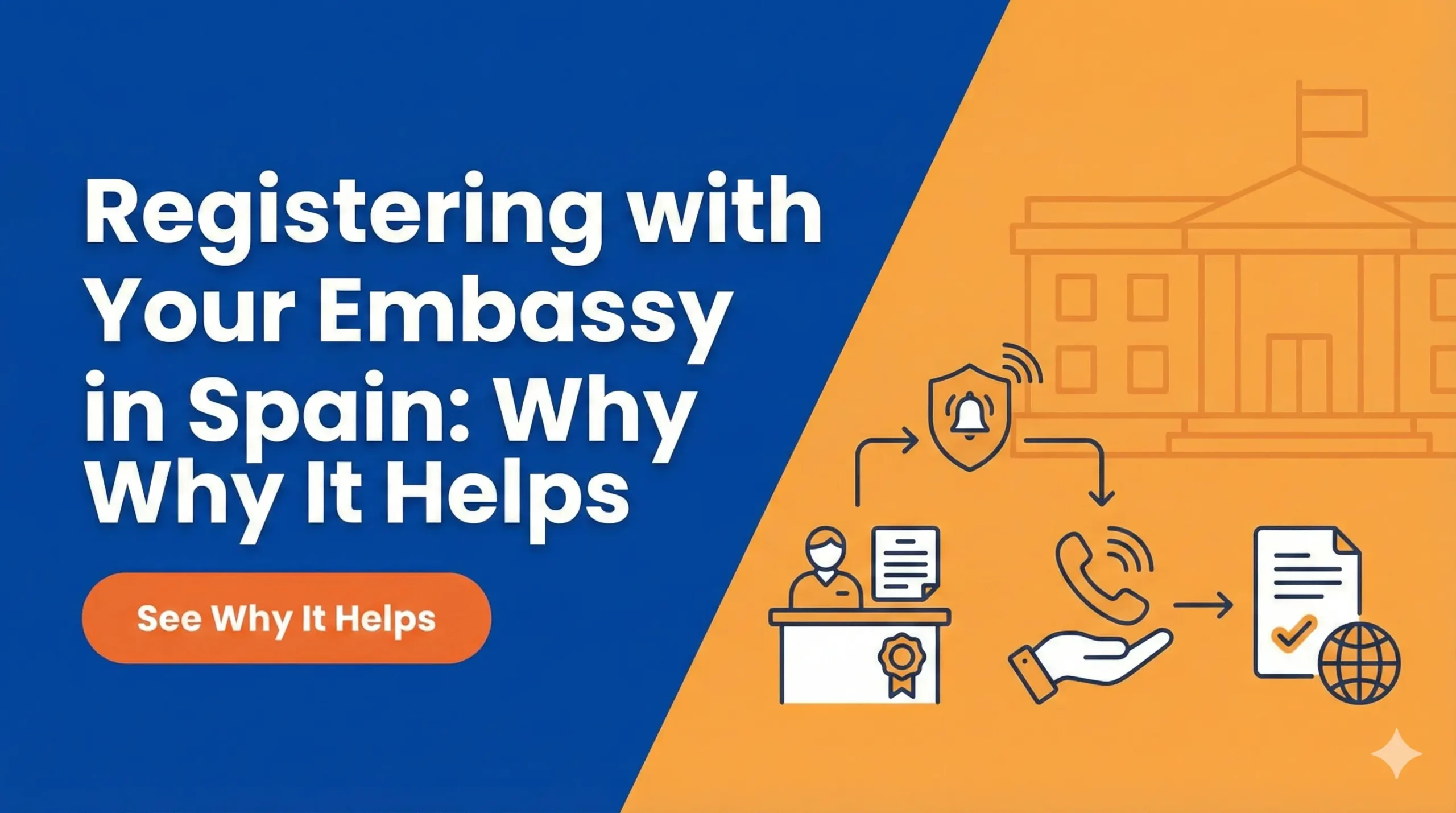
Registering with your home embassy is a critical safety step for expats in Spain. From expedited passport replacement to emergency alerts during natural disasters, this free process connects you to vital resources and ensures you are never truly alone while living abroad.
Disclosure: This post may contain affiliate links. We may earn a commission at no extra cost to you if you make a purchase through these links. Read full disclosure.
The Safety Net You Hope Never to Use
The primary purpose of embassy registration is crisis management. When you move to Spain, you are essentially leaving the direct jurisdiction of your home country’s protective services. If a crisis occurs, the Spanish authorities are responsible for you, but your home government facilitates communication and extraction if necessary.
Natural Disasters and Local Emergencies
Spain is generally a safe country, but it is not immune to natural disasters. In recent years, the country has faced significant wildfires (incendios forestales) during the scorching summer months, particularly in regions like Andalusia and Galicia. Additionally, torrential rains known as DANA (Depresión Aislada en Niveles Altos) frequently cause flash flooding along the Mediterranean coast.
If you are registered with your embassy, you will receive real-time alerts about these dangers in your language. While the Spanish government issues alerts via local channels, these are often in rapid-fire Spanish or Catalan, which can be difficult for newcomers to decipher in a panic. Embassy alerts provide clear, actionable instructions: stay put, evacuate to a specific location, or prepare for power outages.
Political Unrest and Civil Disturbances
While Spain is a stable democracy, political demonstrations are common. Strikes (huelgas) can shut down transportation networks without warning, and regional political tensions can lead to large-scale protests in major cities like Barcelona or Madrid.
Registered citizens often receive “Demonstration Alerts” warning them of planned protest locations to avoid. These updates help you plan your commute and avoid accidentally getting caught in a crowd that could turn volatile.
Lessons from the Pandemic
The COVID-19 pandemic was a wake-up call for the expatriate community. When borders closed and commercial flights were grounded in March 2020, thousands of foreigners found themselves stranded in Spain.
Those who had registered with their embassies were the first to be notified about repatriation flights, special border exemptions, and health protocols. Those who were not registered were left refreshing Twitter feeds and airline websites, often missing out on limited seats home. The registration lists literally became the manifest for rescue operations.
Expediting Lost or Stolen Passports
Spain is one of the world’s most popular tourist destinations, and unfortunately, pickpocketing remains a persistent issue in tourist hubs like Barcelona’s Las Ramblas or Madrid’s Plaza Mayor. Losing your passport is a rite of passage for some, but it is a massive headache for a resident.
If your passport is stolen, you cannot travel outside the Schengen zone, and you may struggle to identify yourself to Spanish authorities during your daily life.
How Registration Helps
If you are already in the consular database, your identity is pre-verified.
- Speed: The consulate does not have to spend days contacting the passport office back home to confirm you are who you say you are. They can pull up your file, see your registration details, and issue an emergency travel document or a replacement passport much faster.
- Verification: In some cases, if you have lost all your ID (wallet and passport gone), having your details on file helps the consular staff verify your identity through security questions based on your registration data.
This is particularly important if you have travel plans coming up. A process that might take two weeks for an unknown applicant could potentially be resolved in a few days for a registered citizen. This efficiency is invaluable when you are trying to finalize other immigration steps, such as those detailed in our guide on Moving to Spain in 2027: Step-by-Step Immigration Checklist.
Family Emergencies and Next of Kin
No one likes to think about the worst-case scenario, but accidents happen. If you are hospitalized in Spain due to a sudden illness or a traffic accident, you may not be in a condition to contact your family.
If you are alone and unconscious, Spanish police or hospital staff will contact your embassy.
- If you are registered: The embassy can immediately access your “Emergency Contact” information and notify your next of kin. They can help your family navigate the Spanish hospital system, explain the situation, and assist with language barriers.
- If you are not registered: The embassy has to wait for your family to realize you are missing and contact them. This delay can cause agonizing uncertainty for your loved ones back home.
Furthermore, in the tragic event of a death abroad, the embassy plays a crucial role in coordinating with the family for the repatriation of remains or local burial. Registration ensures they know exactly whom to call and what your wishes might be.
Administrative Perks: Voting and Taxes
Beyond doom and gloom scenarios, registering offers practical administrative benefits that make expat life smoother.
Exercising Your Right to Vote
Living in Spain does not mean you lose your voice in your home country. Most democracies allow their citizens abroad to vote via absentee ballots. However, the window to request these ballots is often short, and the mail system can be slow.
Embassies frequently use their registration lists to remind citizens of upcoming elections and registration deadlines.
- USA: The Federal Voting Assistance Program (FVAP) works closely with embassy registries to ensure Americans get their ballots.
- Info Sessions: Embassies sometimes host town halls or Q&A sessions about absentee voting processes, and invitations go out to the registered email list.
Proof of Residence for Home Procedures
Sometimes you need to prove to your home government that you don’t live there anymore. This is common for tax purposes (to avoid double taxation or state taxes) or to stop jury duty summons.
A certificate of registration from your embassy can serve as official proof that you are resident in Spain. While your Spanish Empadronamiento in Spain: How to Register Your Address is the local proof, your home authorities often prefer a document issued by their own diplomatic mission.
Country-Specific Registration Systems
Different nations have different names and protocols for this process. Here is how the major English-speaking countries handle it.
United States: The STEP Program
For Americans, the system is the Smart Traveler Enrollment Program (STEP). It is arguably the most robust and proactive system available.
- What it is: A free service that allows U.S. citizens and nationals traveling and living abroad to enroll their trip with the nearest U.S. Embassy or Consulate.
- Benefits: You receive specialized emails called “Massey Alerts” or “Security Messages.” These cover everything from changes in Spanish visa laws to terror threats and weather warnings.
- How to enroll: You create an account on the STEP website. You can mark your stay as “Indefinite” if you are a resident. You can also update your contact info easily if you move apartments within Spain.
Canada: Registration of Canadians Abroad (ROCA)
Canada offers a similar service known as Registration of Canadians Abroad.
- Target Audience: It is strongly recommended for students, workers, and retirees planning to be in Spain for more than a few months.
- Features: In an emergency, the Canadian government will try to contact you to check on your well-being. They also provide updates on safety conditions in Spain.
- Privacy: The information is protected under the Privacy Act and is only accessed by consular officials in specific emergency situations.
United Kingdom: FCDO Travel Advice
The UK used to have a system called LOCATE, but it was discontinued. The British government now takes a different approach.
- Current System: They do not maintain a “list” of residents in the same way the US does. Instead, they urge British nationals to sign up for email alerts regarding Spain on the Foreign, Commonwealth & Development Office (FCDO) website.
- Strategy: While you don’t “register” your address, subscribing to these alerts is the functional equivalent for safety updates. For emergencies, you rely on the 24/7 consular assistance line.
- Note: Because there is no central registry, it is even more important for Brits to keep their passports secure and their travel insurance details shared with family, as outlined in our article on Health Insurance for Spain Visas: Coverage Rules and Policy Checklist.
Australia: Smartraveller
Australians use the Smartraveller portal. Like the UK, they have moved away from a full registration database for every traveler, but for long-term residents, creating a profile and subscribing to updates for Spain is the standard advice.
Comparison of Embassy Services
| Feature | USA (STEP) | Canada (ROCA) | UK (FCDO Alerts) |
| Database Type | Full Registry | Full Registry | Subscription / Alerts |
| Emergency Contact | Yes, strictly used | Yes, strictly used | N/A (Keep family informed) |
| Alert Frequency | High (Protests, Weather, Admin) | Medium (Major events) | High (Travel disruption, Laws) |
| Proof of Residence | Can request Consular inscription | Can request Consular inscription | Not standard |
| Cost | Free | Free | Free |
Addressing Privacy Concerns
In an era of data breaches and surveillance, some expats are hesitant to give their details to the government voluntarily. “Does Uncle Sam need to know exactly where I sleep in Madrid?” is a common question.
It is important to understand the limitations of these registries:
- Not for Tax Enforcement: Generally, the consular database is firewalled from the tax authorities (like the IRS). Registering with STEP does not automatically trigger an audit. The IRS has its own ways of finding you (via banking data sharing); they don’t need the embassy’s help.
- Privacy Laws: Consular data is protected by strict privacy acts (like the Privacy Act of 1974 in the US). It cannot be shared with third parties or commercial entities.
- Voluntary: You provide as much or as little info as you want. If you don’t want to give your phone number, you don’t have to (though it defeats the purpose of emergency alerts).
The goal of the consular staff is citizen services, not surveillance. They are there to help you if you get arrested, sick, or lost—not to spy on your lifestyle.
When Should You Register?
Ideally, you should register before you even leave your home country, or immediately upon arrival in Spain.
- During the Visa Process: While waiting for your visa approval, set up your account. It helps you stay informed about any consular closures that might affect your visa pickup.
- Upon Arrival: Once you have a permanent address in Spain, update your profile. If you are staying in a temporary Airbnb while looking for a flat, use that address and update it later.
- Changes: If you move from Madrid to Valencia, update your registration. The Madrid consulate cannot help you efficiently if they think you are 400km away. This is similar to the requirement to update your local address, as discussed in Empadronamiento in Spain: How to Register Your Address.
How to Register: A General Step-by-Step
While each country has its own portal, the general workflow is consistent.
1. Gather Your Documents
You will need your passport number, your emergency contact’s details (phone and email), and your address in Spain.
2. Create an Account
Visit the specific website for your country (e.g., step.state.gov for US). Create a username and password.
3. Add Your Trip/Residency
Select “Add a Trip.”
- Destination: Spain.
- Date of Arrival: Your entry date.
- Date of Departure: If you are a resident, select “Indefinite” or put a date far in the future (e.g., 5 years later).
4. Input Contact Info
Enter your Spanish mobile number and physical address. If you are a Spain Digital Nomad Visa holder moving around, try to keep this as current as possible, or list your “base” location.
5. Verify
Some systems will send a confirmation email. Click it to activate your enrollment.
Notary Services and Legal Assistance
One of the most frequent non-emergency reasons to visit the embassy is for notary services.
- Property & Power of Attorney: If you are buying property in the US or UK while living in Spain, you often need documents notarized. A Spanish notary is often not accepted by US banks. The US Embassy provides notary services that are legally valid in the US.
- Affidavits: You may need to swear an affidavit for marriage in Spain (proving you are single). The embassy provides this service.
Being registered often makes booking these appointments smoother, as you are already in the system for security clearance to enter the building.
The Distinction: Consulate vs. Embassy
Expats often use the terms interchangeably, but they are different.
- The Embassy: Located in the capital (Madrid). It handles diplomatic relations with the Spanish government.
- The Consulate: Located in major cities (Barcelona, Valencia, Malaga, Seville, etc.). These are the “branch offices” that handle citizen services like passports, notary acts, and emergency assistance.
When you register, you are usually routed to the nearest Consulate. If you live in Barcelona, your point of contact is the US Consulate General in Barcelona, not the Embassy in Madrid. Knowing this distinction saves time during an emergency.
When to De-register
If you decide to leave Spain permanently—perhaps to return home or move to a new country—you should remember to “end your trip” in the registry system.
- Why: If a natural disaster hits Spain after you have left, you don’t want your family to be contacted by the embassy panicking that you are missing in the disaster zone.
- How: Simply log in and set your departure date to the past, or click “Unsubscribe.”
Conclusion
Registering with your embassy is the administrative equivalent of wearing a seatbelt. Most of the time, you won’t notice it’s there. It doesn’t affect the performance of the car, and it takes two seconds to click into place. But on the day you hit unexpected turbulence—be it a lost passport, a global pandemic, or a family crisis—it keeps you secure.
It costs nothing, takes ten minutes, and provides peace of mind that allows you to focus on the enjoyable parts of expat life: the tapas, the fiestas, and the sunny days. So, before you head out to explore your new Spanish city, open a new tab and sign up. It is the smartest travel hack there is.
Once you have secured your safety net, you can turn your attention back to the local bureaucracy. If you haven’t sorted your residency card yet, check out our guide on How to Get the TIE Card in Spain: Fingerprints, Fees, and Pickup to keep your integration moving forward.
References
Primary sources (official)
- U.S. Department of State: Smart Traveler Enrollment Program (STEP) official portal.https://step.state.gov/
- Government of Canada: Registration of Canadians Abroad (ROCA) information and login.https://travel.gc.ca/travelling/registration
- UK Foreign, Commonwealth & Development Office (FCDO): Foreign travel advice and email alert subscription for Spain.https://www.gov.uk/foreign-travel-advice/spain
- Australian Government: Smartraveller portal for Australian citizens abroad.https://www.smartraveller.gov.au/
Other helpful sources
- U.S. Embassy & Consulate in Spain and Andorra: Citizen services, notary appointments, and contact information.https://es.usembassy.gov/
- British Embassy Madrid: Services available to British nationals in Spain.https://www.gov.uk/world/organisations/british-embassy-madrid
Disclaimer
The information provided in this article is for educational and informational purposes only and does not constitute legal or official government advice. Embassy procedures and registration systems (such as STEP or ROCA) are subject to change by the respective foreign ministries. We strongly recommend visiting the official website of your country’s embassy in Spain for the most current instructions.