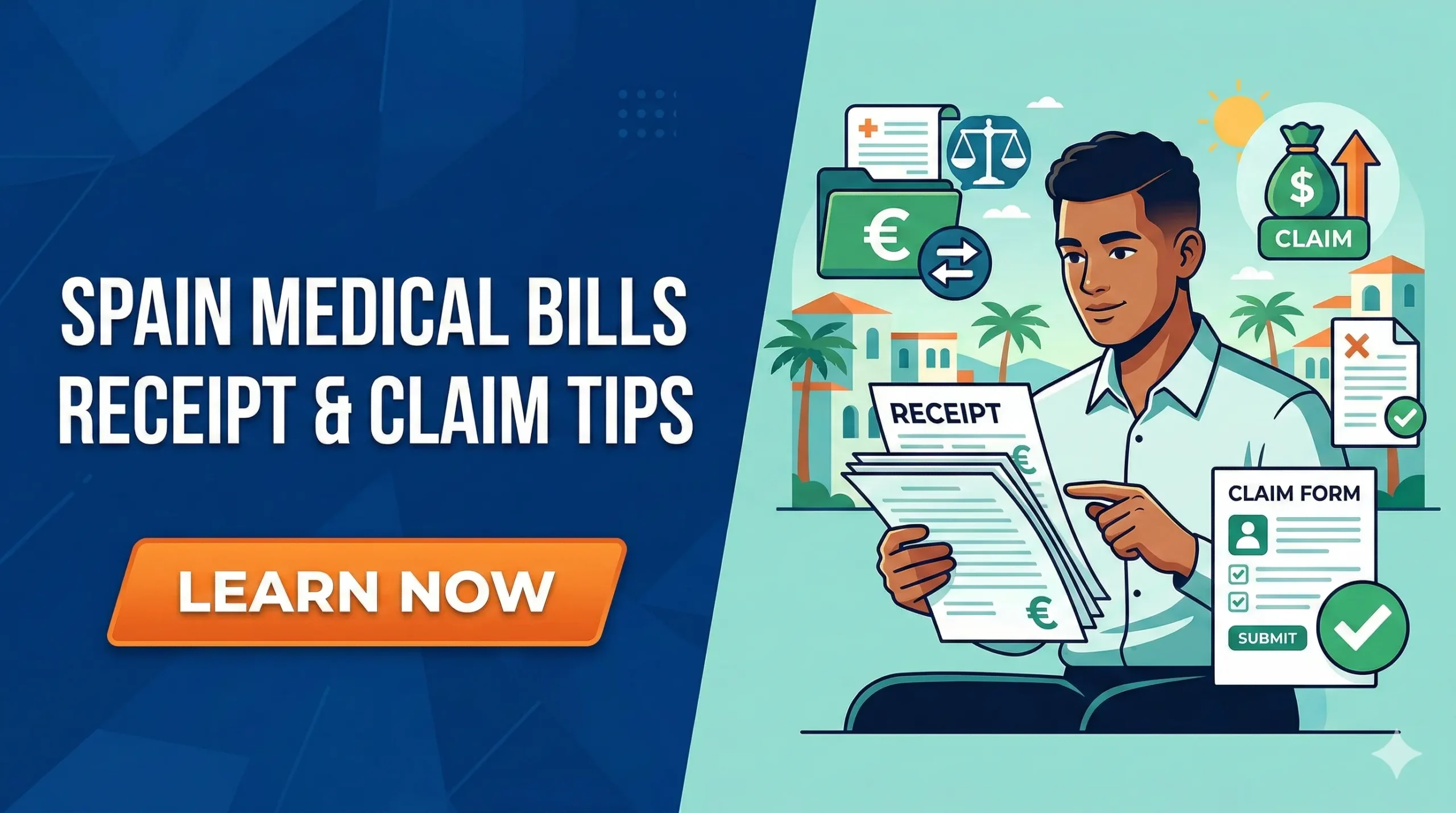
How to Handle Medical Bills in Spain: Receipts, Claims, and Disputes
Disclosure: This article contains affiliate links. If you buy through them, we may earn a commission at no extra cost to you. Read our full disclosure.
Navigating the financial side of healthcare in Spain can be daunting for expats and tourists. This comprehensive guide covers everything from understanding public and private medical invoices to filing insurance claims, managing out-of-pocket costs, and effectively resolving complex billing disputes.
Understanding the Spanish Medical Billing System
Public System Invoicing and Private Billing
Spain’s public healthcare network, the Sistema Nacional de Salud (SNS), operates primarily on a free-at-the-point-of-access model for registered, tax-contributing residents. However, this does not mean the system is entirely without invoices. Many regional health authorities issue what is known as a shadow bill. This document is handed to the patient upon discharge not to collect a financial payment, but to transparently demonstrate the true cost of the medical resources, staff time, and hospital beds utilized during their stay. It serves purely as an educational tool to raise civic awareness about the immense value of the public healthcare infrastructure. You can learn more about registering for this system in our guide on What Is a ‘Centro de Salud’ in Spain and How Do You Register?.
For a much deeper dive into how these two distinct systems compare in terms of access, quality, and eligibility, checking out our extensive guide on the Spain Healthcare System for Expats: Public vs Private is highly recommended. Knowing precisely which system you are legally entitled to utilize will dictate whether you leave the hospital with a shadow bill or a very real demand for immediate payment.
Who Needs to Pay Out of Pocket
While officially registered expat residents who contribute to the Spanish social security system enjoy free public healthcare, not everyone shares this financial privilege. Tourists arriving from non-EU countries, digital nomads operating without public coverage, and expats residing in Spain on specific visas, such as the Non-Lucrative Visa, are generally required to pay entirely out of pocket for any public hospital visits if they do not hold an active private health insurance policy.
Therefore, it is absolutely imperative for temporary visitors and digital nomads to secure comprehensive medical coverage before arriving. Utilizing a globally recognized health safety net like Innoinsure ensures that if you are forced to visit a public or private emergency room as a tourist, you have the financial backing to settle the resulting medical bill without completely draining your travel savings or facing legal repercussions at the border. You can review typical out-of-pocket expenses in our guide on Health Costs in Spain: Typical Co-Pays and Out-of-Pocket Fees.
The Role of the European Health Insurance Card
For citizens of the European Union, the European Economic Area, and Switzerland, the European Health Insurance Card (EHIC) acts as a powerful financial shield against public medical bills in Spain. The EHIC grants temporary visitors the right to access medically necessary, state-provided healthcare under the exact same conditions, and at the exact same cost, as individuals who are permanently insured in Spain.
This means that if you present a valid, unexpired EHIC at a public health center or a state-run hospital emergency room, you will not be billed for the doctor’s consultation, the surgical treatment, or the hospital bed. The complex administrative billing process happens entirely behind the scenes, executed directly between the Spanish Ministry of Health and your home country’s national health system. However, it is vital to understand that the EHIC is not an alternative to comprehensive travel insurance; it strictly does not cover private healthcare facilities, emergency medical repatriation flights, or planned, elective surgeries.
Decoding Your Spanish Medical Invoice
Essential Components of a Legally Valid Factura
When you receive a medical bill from a private Spanish clinic, it must comply with highly strict national invoicing and taxation laws. A legally valid, official invoice in Spain is known as a factura. For this document to be considered legally binding and valid for insurance reimbursement, the factura must clearly display the clinic’s or the independent doctor’s full legal corporate name, their registered fiscal address, and their tax identification number (NIF or CIF).
Additionally, the invoice must include a unique, sequential invoice number, the exact date the consultation or surgical procedure took place, your full personal details including your name, Spanish address, and passport or NIE number, and a highly detailed, itemized breakdown of the medical services provided. Each specific service, whether it is a diagnostic blood test, a localized MRI scan, or the primary doctor’s consultation fee, must be listed on a separate, distinct line with its corresponding price and medical code clearly visible.
Value Added Tax Exemptions on Medical Services
A frequent point of confusion and anxiety for expats reviewing their Spanish medical bills is the application of Value Added Tax, which is known in Spain as the Impuesto sobre el Valor Añadido (IVA). According to the strict guidelines set by the Spanish Tax Agency (Agencia Tributaria), core medical services provided by recognized, licensed healthcare professionals that consist of the direct diagnosis, prevention, and treatment of diseases are legally exempt from IVA.
This means that if you visit a private cardiologist for a heart murmur, undergo a medically necessary appendectomy, or receive an emergency dental extraction due to severe trauma, your final invoice should clearly show a zero percent IVA rate applied to those specific clinical services. The Spanish government fiercely protects essential human healthcare from standard taxation to ensure it remains as financially accessible as possible to the general public.
Translating Common Medical Billing Vocabulary
Navigating a complex medical bill in a foreign language requires a functional baseline understanding of Spanish billing terminology. The term presupuesto translates to a medical quote or a cost estimate. It is highly advisable to explicitly request a written presupuesto before agreeing to any major private medical procedure, such as a knee surgery or extensive dental implants, so you know exactly what your ultimate financial liability will be before you are wheeled into the operating room.
If you are dealing specifically with urgent dental procedures, the vocabulary shifts slightly, frequently including specialized terms like endodoncia for a root canal, empaste for a filling, or extracción for a removal. For a highly specific look at the terminology, triage processes, and expected costs associated with urgent dental scenarios, we highly recommend reading our specialized article on Emergency Dental Care in Spain: Where to Go.
Paying Your Medical Bills and Financial Logistics
Acceptable Payment Methods at Clinics
Paying your medical bills in Spain is generally a smooth and highly modernized process, as private clinics and public hospital billing departments are well-equipped to handle a variety of payment methods. The vast majority of private hospitals, independent specialist clinics, and specialized diagnostic centers readily accept all major credit and debit cards, including Visa and Mastercard. Contactless payments utilizing mobile wallets are also universally accepted for smaller consultation fees or pharmacy runs.
For larger, scheduled surgeries or extended private hospital stays, the clinic’s billing department will usually provide you with an invoice containing their official IBAN. You will typically be granted a specific timeframe, usually between 15 to 30 days, to execute a SEPA bank transfer from your personal account to the hospital’s account. Always remember to meticulously include your unique invoice number and passport details in the concept field of the bank transfer to ensure your payment is accurately tracked and credited to your patient file.
Managing Cross Border Currency Transfers
For expats, retirees, and digital nomads whose primary income, pensions, or savings are held in bank accounts outside the Eurozone (such as in US Dollars, British Pounds, or Canadian Dollars), paying a large medical bill directly from a foreign bank card can be a financially disastrous decision. Traditional, legacy banks are notorious for applying highly aggressive dynamic currency conversion rates and burying hidden international transaction markups in the fine print when you swipe a foreign card at a Spanish medical terminal.
A standard MRI scan can easily end up costing you significantly more once your home bank finishes applying its exchange rate markup and cross-border fees. To completely avoid bleeding money on predatory banking fees during a stressful health crisis, financially savvy expats utilize specialized financial technology platforms. By actively opening a multi-currency account with a leading service like Wise, you can convert your home currency directly into Euros at the true, transparent mid-market exchange rate.
Payment Plans and Installment Options
High-cost medical procedures, particularly in the highly privatized fields of elective surgery, adult orthodontics, and complex fertility treatments, can place a sudden, severe, and unexpected strain on an expat’s monthly finances. Recognizing this reality, many large private medical conglomerates and major dental chains in Spain proactively offer internal financing options to their patients.
For newly arrived expats or digital nomads who do not yet have a deep, verifiable financial footprint in Spain, securing this local third-party financing can be incredibly difficult. In these instances, negotiating a staggered payment schedule directly with the independent doctor or clinic manager—such as paying 50 percent of the total cost upfront before the procedure and the remaining 50 percent upon the successful completion of the medical treatment—is a highly common and widely accepted business practice in the Spanish private medical sector.
Navigating the Insurance Claims Process
Direct Billing Versus Reimbursement Models
If you hold a private health insurance policy in Spain, the specific manner in which your medical bills are handled depends entirely on the contractual structure of your chosen policy. The most common, affordable, and stress-free model for expats is the direct billing network, known locally as the cuadro médico. Under this highly integrated system, you are required to visit clinics, hospitals, and specialists that have a pre-existing, negotiated financial contract with your insurance provider.
Alternatively, some expats opt for a premium reimbursement policy. This high-tier model offers the ultimate medical freedom, allowing you to visit absolutely any doctor, specialist, or hospital in the world, regardless of whether they belong to a specific network. However, the financial burden shifts temporarily to you; you must pay the medical bill entirely out of pocket upfront at the clinic, and subsequently submit the itemized invoice to your insurer. The insurer will then refund you a percentage, usually between 80 and 100 percent, of the total cost directly into your bank account based on your specific policy limits.
| Feature | Direct Billing (Cuadro Médico) | Reimbursement (Reembolso) |
| Upfront Out-of-Pocket Cost | None (or small pre-agreed copay) | 100% of the clinic’s invoice |
| Choice of Doctor/Clinic | Restricted to the insurer’s network | Unlimited (Any doctor worldwide) |
| Administrative Burden | Very Low (Show card and leave) | High (Must submit invoices/reports) |
| Monthly Premium Cost | Generally lower and more affordable | Significantly higher premium |
Step by Step Guide to Submitting a Claim
If you are operating under a premium reimbursement policy or utilizing a global travel medical plan, successfully claiming your money back requires meticulous organization and attention to detail. The very first step is to ensure you do not leave the clinic without a fully itemized, officially stamped factura, alongside a formal medical report meticulously detailing your diagnosis, the exact symptoms presented, and the specific treatment prescribed by the attending physician.
If you are an expat utilizing international health coverage rather than a localized Spanish policy, you may occasionally be required to translate the Spanish medical documents into English before submitting your formal claim. While some top-tier international providers employ multilingual claims teams, providing a clear, accurate, and professional translation of the medical report will significantly expedite the reimbursement timeline and prevent unnecessary, frustrating administrative delays.
Common Reasons for Claim Denials
Opening an email to find a claim denial letter from your health insurance provider is an incredibly frustrating and financially terrifying experience. One of the most frequent reasons for a denied medical bill in Spain is the patient’s failure to secure a prior authorization (autorización previa). Many private policies strictly require you to obtain explicit, digital permission from the insurer before undergoing expensive diagnostic tests, elective surgeries, or specialized physical therapy. If you skip this bureaucratic step and simply book the scan, the insurer is legally within their rights to refuse payment entirely.
Another highly common pitfall involves the strict waiting periods (carencias) embedded deeply in the fine print of almost all Spanish private health insurance contracts. If you submit a massive bill for a complex joint surgery or a childbirth delivery only three or four months into your brand-new policy, the claim will almost certainly be categorically denied, as these high-cost medical events universally require the policy to have been active and paid into for 8 to 10 months beforehand. Ensure your policy matches your immediate needs by reviewing terms carefully with a broker like Innoinsure.
Resolving Medical Billing Disputes and Overcharges
Identifying Administrative Errors and Overcharges
Medical billing errors occur globally on a daily basis, and the Spanish private healthcare sector is absolutely no exception. Because private clinics generate their core revenue through complex fee-for-service models, the intricate coding of medical procedures, surgical room time, and diagnostic tests can sometimes lead to genuine administrative mistakes. As an empowered patient, you must proactively and aggressively audit your factura to ensure you are only paying for the clinical services you actually received.
If you identify a discrepancy on your bill, your first course of action should always be to address it directly and politely with the clinic’s billing department or the dedicated patient care unit. In many cases, these errors are genuine administrative oversights that can be quickly and easily rectified by the staff issuing a corrected, amended invoice. Always approach the conversation calmly but firmly, presenting your signed medical report as undeniable proof of the actual services rendered.
Filing a Formal Complaint with OMIC
If a private hospital or independent clinic stubbornly refuses to correct a blatant billing error, denies you your legal right to an itemized invoice, or actively engages in highly deceptive pricing practices, you have incredibly powerful legal recourse as a consumer residing in Spain. Every single commercial establishment operating in the country, including highly prestigious private medical and dental clinics, is legally mandated by the state to carry official, standardized complaint forms known as Hojas de Reclamaciones. For a comprehensive overview of your rights, see our guide on How to Make a Complaint About Healthcare in Spain: Patient Rights.
You have the absolute, undeniable right to ask the clinic’s receptionist for this specific form at any time. Simply asking for the Hoja de Reclamaciones often forces stubborn clinic management to immediately take your billing dispute seriously, as they know that official state oversight and potential administrative fines are imminent. The form consists of three color-coded carbon copies: a white original intended for the regional consumer authority, a green copy for you to keep as proof, and a pink copy for the clinic to retain in their files.
Seeking Mediation and Legal Advice
When you officially submit an Hoja de Reclamaciones, the document is processed and investigated by the Municipal Consumer Information Office, universally known across Spain by its acronym, OMIC. The OMIC acts as a completely free, state-sponsored, and highly objective mediator between you, the aggrieved patient, and the private medical clinic. Their primary goal is to resolve the billing dispute fairly and extrajudicially, keeping the matter out of the backlogged Spanish court system.
If the OMIC mediation ultimately fails and the disputed financial amount is substantially high, your final, absolute recourse is to enter the Spanish judicial system. For minor claims involving amounts under €2,000, Spanish civil law allows you to file a verbal trial directly at the local courts without the mandatory, expensive need to hire a private lawyer or a legal representative. This streamlined legal avenue makes fighting unjust, predatory medical bills a financially viable option for determined expats who are willing to patiently navigate the local legal bureaucracy.
Managing Pharmacy Receipts and Outpatient Costs
The Spanish Copayment System
Once you are officially discharged from a public hospital ward or step out of a private clinic, your medical financial journey usually continues directly at the local neighborhood pharmacy. The Spanish public healthcare system utilizes a strict pharmaceutical copayment system known as the copago farmacéutico. When you hand your public SIP health card to the local pharmacist, the state’s centralized computer network dictates exactly what percentage of the medication’s cost you must pay for out-of-pocket based on your tax bracket.
For expats managing ongoing, chronic conditions who rely heavily on the public system, these monthly, recurring copayments represent the absolute bulk of their out-of-pocket healthcare expenses. To better understand how to seamlessly navigate the regional electronic prescription networks and intelligently manage the logistics of ongoing, long-term pharmacy runs, we highly recommend reading our detailed, step-by-step breakdown on Medication Refills in Spain: How Renewals Work.
Retaining Receipts for Tax Deductions
While a simple, anonymous pharmacy ticket is perfectly sufficient for a quick, everyday purchase of ibuprofen, if you are actively filing a reimbursement claim with a private insurance company for highly expensive, out-of-network medications, the standard receipt will simply not suffice. You must explicitly and politely ask the pharmacist to issue a formal, named factura bearing your full legal name, your registered Spanish address, and your NIE or passport number before they close the register till.
For instance, specific regions like the Canary Islands, Cantabria, or Valencia sometimes allow resident taxpayers to legally deduct a percentage of their out-of-pocket expenses related to very specific medical events. These can include the high costs of treating rare genetic diseases, acquiring specialized, custom-built orthopedic devices, or paying for exceptionally costly optical and dental care for minors. Actively consulting with a licensed, local Spanish tax advisor ensures you are legally maximizing any and all available regional healthcare deductions. Ensure any cross-border tax payments or professional tax advisor fees are managed efficiently through an account like Wise to avoid poor bank rates.
Alternative Solutions for Outpatient Wellness
Managing your overall outpatient health costs in Spain isn’t just about paying for prescription drugs; it also involves maintaining a solid, preventative baseline of holistic wellness. Expats frequently experience severe sticker shock when attempting to purchase non-prescription, preventative wellness items, such as high-quality daily multivitamins, specialized vegan probiotics, melatonin, or organic joint supplements, in local Spanish pharmacies. In Spain, these specific items are classified as premium goods and subjected to massive retail markups.
Furthermore, certain natural wellness products and high-dose supplements that are completely ubiquitous and cheaply available in North American or British supermarkets can be incredibly difficult to locate in traditional, highly regulated Spanish pharmacies. To effectively circumvent these exorbitantly high local costs and limited product selections, the savvy expat community relies almost entirely on international e-commerce health platforms like iHerb.
By utilizing highly specialized global retailers, expats can easily, legally, and affordably source a massive array of trusted, high-quality international supplement brands at highly competitive prices. Ordering your daily wellness regimen online through iHerb and having it shipped directly to your Spanish residence is a highly effective, proven financial strategy. It allows you to aggressively protect your overall healthcare budget from local pharmacy markups while ensuring your preventative health and wellness routine remains completely uninterrupted during your life abroad.
References
Primary sources (official)
- Ministerio de Sanidad (Ministry of Health) – Asistencia Sanitaria y Facturación: https://www.sanidad.gob.es/
- Agencia Tributaria (Spanish Tax Agency) – Exenciones en operaciones médicas y sanitarias (IVA): https://sede.agenciatributaria.gob.es/Sede/ayuda/manuales-videos-folletos/manuales-practicos/manual-iva-2021/capitulo-3-entregas-bienes-servicios-profesionales/entregas-bienes-servic-realizadas-empresarios-profesionales/operaciones-exentas/exenciones-operaciones-interiores/exenciones-operaciones-medicas-sanitarias.html
- Ministerio de Derechos Sociales, Consumo y Agenda 2030 – Hojas de Reclamaciones y OMIC: https://www.consumo.gob.es/
Other helpful sources
- European Commission – European Health Insurance Card (EHIC): https://employment-social-affairs.ec.europa.eu/policies-and-activities/moving-working-europe/eu-social-security-coordination/european-health-insurance-card_en
Disclaimer
The information provided in this article is for educational and informational purposes only and does not constitute legal, medical, or financial advice. Spanish tax laws, insurance regulations, and healthcare billing protocols are highly complex and subject to frequent legislative updates by national and regional authorities. Always consult directly with a qualified legal professional, a registered Spanish tax advisor, or your specific insurance provider regarding your personal billing disputes, tax deductions, or insurance claims.