Cash vs Card in Spain: What’s Accepted and Where
Disclosure: This article contains affiliate links. If you buy through them, we may earn a commission at no extra cost to you. Read our full disclosure.
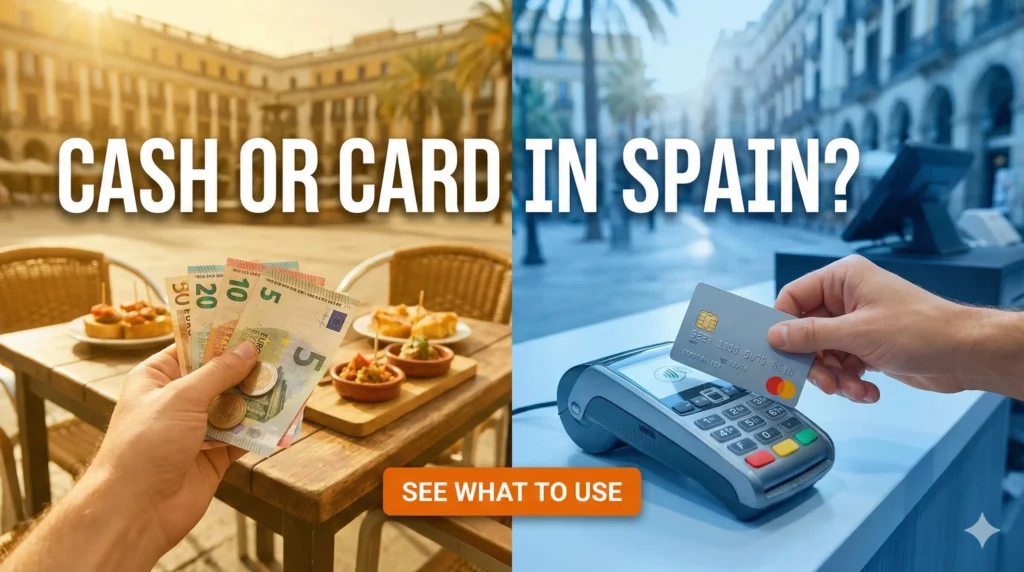
Navigating payments in Spain requires understanding strict new cash limit laws, the widespread adoption of contactless cards, and the booming popularity of the Bizum mobile network. This guide explains legal thresholds, regional payment preferences, and practical tips for managing your money seamlessly.
The Legal Limits on Cash Payments in Spain
If you are moving to Spain from a country where cash transactions are unregulated, the Spanish legal framework will require a significant adjustment. The Spanish government, under the purview of the Agencia Tributaria (the Spanish Tax Agency), heavily monitors the flow of physical currency.
The primary mechanism for this oversight is Law 11/2021, widely known as the Anti-Fraud Law. Implemented to combat the underground economy, money laundering, and tax evasion, this legislation places strict, non-negotiable caps on the amount of physical cash that can change hands during a business transaction.
The Standard Threshold for Residents
If you are a resident of Spain, the law dictates that you cannot make a cash payment of €1,000 or more when at least one of the parties involved in the transaction is acting in a professional or business capacity.
This means if you are buying a television from an electronics store, paying a mechanic for car repairs, or hiring a lawyer, and the total bill is €1,000 or higher, the entire amount must be paid via a traceable electronic method, such as a credit card, debit card, or bank transfer.
A common misconception is that you can split the payment to bypass the rule. For example, if an invoice totals €1,200, many people mistakenly believe they can pay €900 in cash and put the remaining €300 on a credit card. This is illegal under Spanish law. The €1,000 limit applies to the total value of the transaction. You cannot divide the payment into installments or use mixed payment methods to circumvent the threshold. If the total invoice is €1,000 or more, zero euros can be paid in cash.
The Tourist Exemption for Non Residents
The Spanish government recognizes that international tourists often travel with large amounts of physical currency. Therefore, an exception exists: if the payer is a natural person who does not have their tax domicile in Spain and is not acting as a business professional, the cash payment limit is raised to €10,000 (or the equivalent in a foreign currency).
To utilize this higher limit, the tourist or non-resident must be able to prove their status to the merchant, usually by presenting a foreign passport and confirming they do not hold a Spanish tax identification number (NIE). However, once you establish residency and become a tax resident, you are immediately subject to the strict €1,000 limit.
Private Transactions Between Individuals
The €1,000 limit only applies when a business or professional is involved. If a transaction occurs strictly between two private individuals—such as buying a second-hand bicycle from a neighbor or purchasing a used sofa through an online classifieds platform like Wallapop—the cash limit remains at the older threshold of €2,500.
Penalties for Breaking the Cash Law
The penalties for violating the cash limit are severe. The Tax Agency imposes a fine equal to 25% of the total amount paid in cash.
Crucially, Spain enforces “joint liability” for this infraction. This means both the payer (the customer) and the payee (the business) are considered equally guilty, and the tax authority can demand the full 25% fine from either party. However, there is a whistleblower clause: if one of the parties reports the illegal cash transaction to the Tax Agency within three months of it occurring, the reporting party is completely exempted from the penalty, while the other party bears the full brunt of the fine.
The Consumer Right to Pay in Cash
While the government is actively restricting large cash movements, it is simultaneously protecting the right of consumers to use physical money for everyday, low-value purchases.
During the height of the digital payment boom, many Spanish retailers and cafes began erecting “Cards Only” signs, refusing to accept coins and banknotes. This sparked a backlash, as it financially excluded elderly populations, minors, and individuals without access to modern banking infrastructure.
In May 2022, the Spanish government enacted the General Law for the Protection of Consumers and Users (Royal Decree 24/2021). This decree made it mandatory for all physical retail establishments to accept cash for any transaction under the €1,000 legal limit.
Refusing a cash payment is now classified as a consumer rights violation in Spain. A shop owner cannot legally force you to pay for your morning coffee or your groceries with a card. While a merchant can ask politely if you have exact change, they cannot deny you service simply because you wish to pay with a legitimate fifty-euro note.
Paying Rent The Electronic Mandate
One specific area where cash has been almost entirely eliminated is the housing market. Historically, it was not uncommon for tenants to pay their monthly rent to their landlord in physical envelopes of cash, a practice that heavily fueled the undeclared rental economy.
With the passing of the landmark Ley de Vivienda (Housing Law) in May 2023, the rules changed dramatically. The law now mandates that all rent payments for standard residential leases must be executed via electronic means, most commonly a recurring bank transfer.
Even if your rent is under the €1,000 commercial cash limit, it must be paid digitally. There are extremely narrow exceptions to this rule—such as if either the landlord or the tenant lacks a bank account and resides in a highly vulnerable rural area—but for the vast majority of the population, cash is no longer an acceptable way to secure housing. For more strategies on navigating the highly regulated Spanish property market, you can consult our dedicated resource on Finding Long-Term Rentals in Spain.
Card Acceptance and the Contactless Revolution
If you are carrying a Visa or Mastercard, you will face virtually zero friction when spending money in Spain. These two networks dominate the European payment landscape. American Express, however, is a different story; while it is accepted at luxury hotels, major supermarket chains, and high-end retail stores, the vast majority of small, independent Spanish businesses will reject Amex due to its higher merchant processing fees.
The true revolution in Spain has been the universal adoption of Contactless technology (known locally as pago sin contacto).
Every modern point-of-sale (POS) terminal in the country is equipped with near-field communication (NFC) technology. You can tap your physical card, your smartphone via Apple Pay or Google Wallet, or your smartwatch to pay for almost anything.
For contactless security, the PIN threshold in Spain is generally set at €50. If your contactless purchase is under €50, the payment will process instantly without requiring you to enter your personal identification number. For transactions over €50, the terminal will prompt you to input your PIN to authorize the payment.
Minimum Spend Requirements
In the past, many Spanish cafes and convenience stores enforced a “minimum card spend” of five or ten euros to offset the processing fees levied by the banks. Today, banking regulations and competitive merchant services have driven these fees down significantly. While you may still occasionally spot a faded sign in a rural bakery demanding a €5 minimum for card usage, it is incredibly rare in urban centers. It is completely normal and culturally acceptable to pay for a €1.50 espresso or a €2.00 metro ticket using your smartphone.
To avoid foreign transaction fees levied by your home country’s bank when making dozens of small daily purchases, establishing a local financial footprint is highly advisable. You can learn how to navigate the required paperwork in our guide to Setting Up a Spanish Bank Account.
The Rise of Bizum for Mobile Payments
While Apple Pay and Google Wallet dominate commercial retail transactions, peer-to-peer (P2P) payments in Spain are entirely monopolized by a single, uniquely domestic platform: Bizum.
If you live in Spain, understanding and utilizing Bizum is not optional; it is a fundamental requirement of modern social life. Bizum is an instant payment network backed by almost every major banking institution in the country. Unlike Venmo or CashApp, Bizum is not a standalone application that you download from an app store. Instead, it is integrated directly into your existing Spanish mobile banking app.
How Bizum Works
Bizum links your Spanish bank account (IBAN) directly to your Spanish mobile phone number. To send money to a friend, you do not need their bank routing details; you simply select their name from your phone’s contact list, type in the amount, and hit send. The funds are transferred from your bank account to theirs in less than five seconds, 24 hours a day, 365 days a year, completely free of charge.
Where Bizum is Used
- Splitting Bills: If you go out for dinner with five Spanish colleagues, the restaurant will rarely split the bill across six different credit cards. One person will pay the entire total with their card, and the other five will instantly “Bizum” their share to the payer before leaving the table.
- Small Merchants: Many independent market stall owners, freelance tutors, and personal trainers now accept Bizum as a primary form of payment, displaying their phone number on a small placard.
- Online Shopping: Major Spanish e-commerce retailers have integrated Bizum into their checkout portals, allowing you to pay by simply entering your phone number and authorizing a push notification on your banking app.
Because Bizum requires a Spanish IBAN, it is the primary reason why expatriates must open a local bank account immediately upon arrival. Tracking these seamless, instant transfers is an important part of managing your monthly budget; you can explore realistic financial planning strategies in Cost of Living in Spain: Monthly Budget Guide.
When to Use Cash Versus Card
Despite the digital convenience, carrying a small amount of physical euros is still a smart strategy. The decision to use cash or card often comes down to the specific environment and the unwritten rules of Spanish etiquette.
Public Transport and Taxis
The transportation sector has modernized rapidly. By law, all official taxis in major cities like Madrid, Barcelona, and Valencia must accept credit cards, regardless of how small the fare is. However, the card machines occasionally experience connectivity issues, so having cash as a backup is highly recommended.
For public transit, major city bus networks and metro stations all accept contactless payments, and many allow you to tap your physical credit card directly at the turnstile. You can find a deeper dive into navigating these systems in our overview of Public Transport in Spain: AVE, Metro, and Buses.
Tipping Culture (La Propina)
Tipping in Spain operates very differently than in North America. Service staff are paid a standard living wage, and tipping is never mandatory. However, leaving a small token of appreciation for good service is common practice.
In a cafe, leaving the small change (coins) from your bill is sufficient. In a nice restaurant, leaving 5% to 10% is considered generous. Crucially, tips should always be left in cash. While some modern card terminals allow you to add a percentage tip digitally, many restaurant workers report that credit card tips are absorbed by the business and never reach the staff. Leaving physical coins on the table guarantees your server receives the gratuity.
Street Markets and Rural Pueblos
Spain is famous for its open-air street markets (mercadillos), which sell everything from fresh produce and vintage clothing to antique furniture. While a few tech-savvy vendors have adopted portable card readers or Bizum, cash remains the absolute king of the mercadillo. You cannot negotiate a discount on a vintage lamp using a credit card.
Similarly, if you travel outside the major metropolitan areas into the deep interior of the country or the remote coastal villages, cash becomes much more necessary. In small pueblos, internet connectivity for portable card machines can be unreliable, and traditional, family-run establishments heavily prefer the immediacy of physical currency.
Managing ATM Withdrawals and Hidden Fees
If you need to restock your physical wallet, navigating Spanish ATMs requires caution, particularly if you are using a foreign debit card.
Avoiding Independent ATMs
You should strictly avoid independent, non-bank ATMs that are not attached to a recognizable financial institution. Brands like Euronet, Cashzone, and Euro Automatic Cash aggressively target tourist areas, airports, and convenience stores. These machines exist almost entirely to profit off massive, unavoidable withdrawal fees that can reach upwards of four to seven euros per transaction. Always look for an ATM physically attached to a major Spanish bank like Santander, BBVA, or CaixaBank.
The Dynamic Currency Conversion Trap
If you use a card issued outside the Eurozone (such as a US Dollar or British Pound account), the Spanish ATM will attempt a highly profitable trick known as Dynamic Currency Conversion (DCC).
The screen will display a message asking if you would like to “Pay in your home currency” or “Let the ATM handle the conversion,” often showing you the exact amount it will cost in your home currency alongside a terrible exchange rate. The button to accept this offer is usually bright green, while the button to decline it is red, making it look like an error.
Always press “Decline Conversion” or “Proceed Without Conversion.” By declining, the ATM will dispense your euros but will bill your home bank in euros, allowing your own bank (or Visa/Mastercard) to perform the conversion at the true, mid-market exchange rate. Accepting the ATM’s conversion offer guarantees you will lose anywhere from 3% to 10% of your money to a hidden markup. If you are regularly transferring large sums to fund your life abroad, understanding how to mitigate these exchange rate losses is vital. You can learn more about protecting your wealth in Understanding Spanish Taxes for Expats.
Payment Methods at a Glance
To summarize the complex Spanish payment ecosystem, use the following table as a quick reference guide for your daily activities.
| Transaction Type | Best Payment Method | Legal & Cultural Notes |
| Large Purchases (Over €1,000) | Card / Bank Transfer | Legally required for residents; cash is strictly forbidden and heavily fined. |
| Rent Payments | Bank Transfer | Mandated by the 2023 Housing Law; cash rent is generally illegal. |
| Supermarkets & Retail Shops | Contactless Card | Universally accepted; no minimum spend requirements. |
| Splitting Dinner with Friends | Bizum | The social standard; requires a Spanish bank account. |
| Street Markets (Mercadillos) | Cash | Essential for bargaining; many vendors do not have card terminals. |
| Restaurant Tipping (Propina) | Cash | Ensures the money actually reaches the waiter directly. |
| City Taxis | Card / Cash Backup | Cards are legally mandated in cities, but machines can lose signal. |
Conclusion
The reality of spending money in Spain today is a story of dualities. The government is rapidly forcing the economy into a digital, transparent era to combat fraud, making a local bank account and a contactless card absolutely essential for survival. At the same time, cultural traditions and strong consumer protection laws ensure that physical euros remain a vital, guaranteed method of payment for everyday life.
For anyone moving to or traveling through Spain, the optimal strategy is a hybrid one. Embrace the extreme convenience of Apple Pay for your morning coffee, link your phone to the Bizum network to participate effortlessly in Spanish social life, but always keep forty or fifty euros tucked into your wallet for tipping, market days, and rural excursions. By understanding the strict legal limits on large cash transactions and avoiding the expensive currency conversion traps at local ATMs, you can navigate the Spanish economy with the confidence of a true local.
References
Primary Sources Official
- Agencia Tributaria (Limitations on Cash Payments): https://sede.agenciatributaria.gob.es/
- Boletín Oficial del Estado (Law 11/2021 on Anti-Fraud Measures): https://www.boe.es/
- Banco de España (Consumer Rights and Cash Acceptance): https://clientebancario.bde.es/
Other Helpful Sources
- Stripe (Cash Payment Limits in Spain 2026): https://stripe.com/resources/more/cash-payment-limits-in-spain
- Sanitas Health Insurance (Expat Tips on Cash Limits): https://www.healthplanspain.com/blog/expat-tips/1199-cash-payment-limits-spain.html
Disclaimer
The information provided in this article is for educational and informational purposes only and does not constitute formal legal, tax, or financial advice. Spanish cash payment limits, housing laws requiring electronic rent payments, and ATM withdrawal fees are subject to frequent legislative updates and banking policy changes. We strongly recommend consulting official government portals or a registered financial advisor in Spain regarding any transactions that approach the legal cash thresholds.