What Happens to Your eSIM When You Leave Spain: Expiry and Reuse
Disclosure: This article contains affiliate links. If you buy through them, we may earn a commission at no extra cost to you. Read our full disclosure.
Leaving the vibrant streets of Spain, you’re often left wondering about those pesky administrative details you just managed to conquer – and that includes your handy eSIM. We’ve all been there, thinking we’ve finally got our digital ducks in a row with a new eSIM for navigating Spain, only to immediately start worrying about what happens when you step foot outside the country. Do you lose your data? Can you use it again? This guide is here to shed light on what truly happens to your eSIM when you bid adiós to Spain, and how you can stay connected seamlessly, no matter where your next adventure takes you.
Understanding eSIMs and International Travel from Spain
When you first arrived in Spain, embracing the eSIM was probably a huge relief. No more fumbling with tiny physical SIM cards, no more searching for a local shop the moment you landed – just scan a QR code, and voilà, you're connected. But the simplicity of getting connected can often obscure the nuances of how these digital marvels truly work, especially when your travels extend beyond a single country.
The Convenience (and Confusion) of eSIMs for Expats
For us expats, eSIMs have been a game-changer. Imagine landing in Madrid, hopping on the metro, and having Google Maps instantly tell you where to go, all thanks to a plan you activated while still at home. It bypasses the dreaded data roaming charges that used to sting our wallets whenever we crossed a border. In Spain, local providers like Orange or Vodafone offer great eSIM options, making it easy to grab a data-only plan or even a full package with a local number.
However, this convenience often comes with a dose of "what now?" The moment you start planning that weekend trip to Portugal or a longer journey home, the questions bubble up. Is this Spanish eSIM going to magically work across the border? Will I just lose all my remaining data? It’s a common frustration, and one that many of us have faced, often learning the hard way. The beauty of eSIMs is their flexibility, but understanding their limitations is key to truly harnessing that power without a hitch.
Why Your Spanish eSIM Might Not Work Elsewhere
Here's the rub: most country-specific eSIM plans, including those you bought for Spain, are designed to work exactly where they say they will – in Spain. It's not a conspiracy, just how telecommunications providers structure their offerings.
Think of it this way: when you purchase a local data plan, whether it’s a physical SIM or an eSIM, you're essentially buying access to a specific network within a defined geographical area. A Movistar eSIM, for example, is configured to connect to Movistar's network (or its partners) within Spain. Once your device detects that it's no longer within the geographical boundaries where that network operates, or if the plan explicitly states it's only valid for Spain, your connectivity will simply stop.
This is different from traditional roaming, where your home country's physical SIM might allow you to connect to a partner network abroad, but usually at an eye-watering cost. With a country-specific eSIM, it’s often a hard stop. Even if you have data left on your plan, it becomes inaccessible outside of Spain. This is why many experienced travelers and long-term expats often turn to solutions designed specifically for international or regional use. If you're pondering how to navigate the intricacies of the broader Spanish mobile landscape, our guide on Mobile Phone Plans in Spain: Prepaid vs Contract for Foreigners might offer some more local insights.
Expiry and Validity: What Happens to Your eSIM Data After Leaving Spain
So, you've packed your bags, your passport is ready, and you're just about to cross the border. What's the deal with that Spanish eSIM you've been relying on? It's not as simple as flipping a switch, but understanding the mechanics will save you a headache (and potentially some money!).
The Clock is Ticking: Understanding eSIM Validity Periods
The most crucial thing to grasp about eSIM plans, especially those for a single country like Spain, is that they come with two main limitations: a data allowance and a validity period. You might buy a plan that gives you, say, 10GB of data, valid for 30 days.
- Data Allowance: This is straightforward – once you've used up all 10GB, your data connection will cease, regardless of how many days are left on your plan.
- Validity Period: This is the time limit. If you only use 2GB of your 10GB, but 30 days have passed since activation, your plan expires. The remaining 8GB is simply gone.
Whichever comes first dictates the end of your plan. It's like a pre-paid ticket with an expiration date or a limited number of rides. Once that date hits, or those rides are used up, the ticket is invalid. So, even if you leave Spain with a generous amount of data still showing on your phone, if the validity period expires while you're in France, that data is no longer accessible. This is a common point of confusion for many new to eSIMs, so it’s worth checking those terms and conditions carefully before purchase. For general connectivity needs, our comprehensive guide on Internet in Spain: Choosing Fiber, Mobile, and Bundles can provide a good overview of what's available.
Geographical Limitations: Why Your Spain eSIM Stays in Spain
Beyond the data and time limits, the most significant factor for international travel is the geographical restriction. Unless explicitly stated as a regional or global plan, an eSIM purchased for "Spain" will only work within Spain.
Let's imagine you're taking the high-speed AVE train from Barcelona to Paris. As you zoom past the Pyrenees and cross into France, your Spanish eSIM will likely wave goodbye to its network connection. Even if you had 5GB left and a week until your validity expired, your phone will simply show "No Service" or "No Internet Connection" for that eSIM profile because it cannot connect to a Spanish network (or its designated roaming partners, if any were included in your specific plan, which is rare for single-country data eSIMs).
This is precisely why a dedicated solution for multi-country travel is so vital for the wandering expat. While your primary Spanish SIM might have some expensive roaming options, an eSIM designed for international use, like those from Airalo, offers a far more sensible and cost-effective approach. These platforms curate plans that are designed to work across multiple countries or even continents, giving you uninterrupted service as you hop from one country to the next without thinking twice about your connectivity. Before you embark on your next trip, you might also want to review Traveling With Medication in Spain: Practical Carry-On Tips to ensure all your essentials are sorted.
What Happens to the eSIM Profile Itself?
Now, here's a subtle but important distinction: what happens to the eSIM profile versus the data plan itself?
When you install an eSIM, you're downloading a digital profile onto your phone. This profile is essentially a digital representation of a SIM card. The data plan you purchased is then linked to this profile.
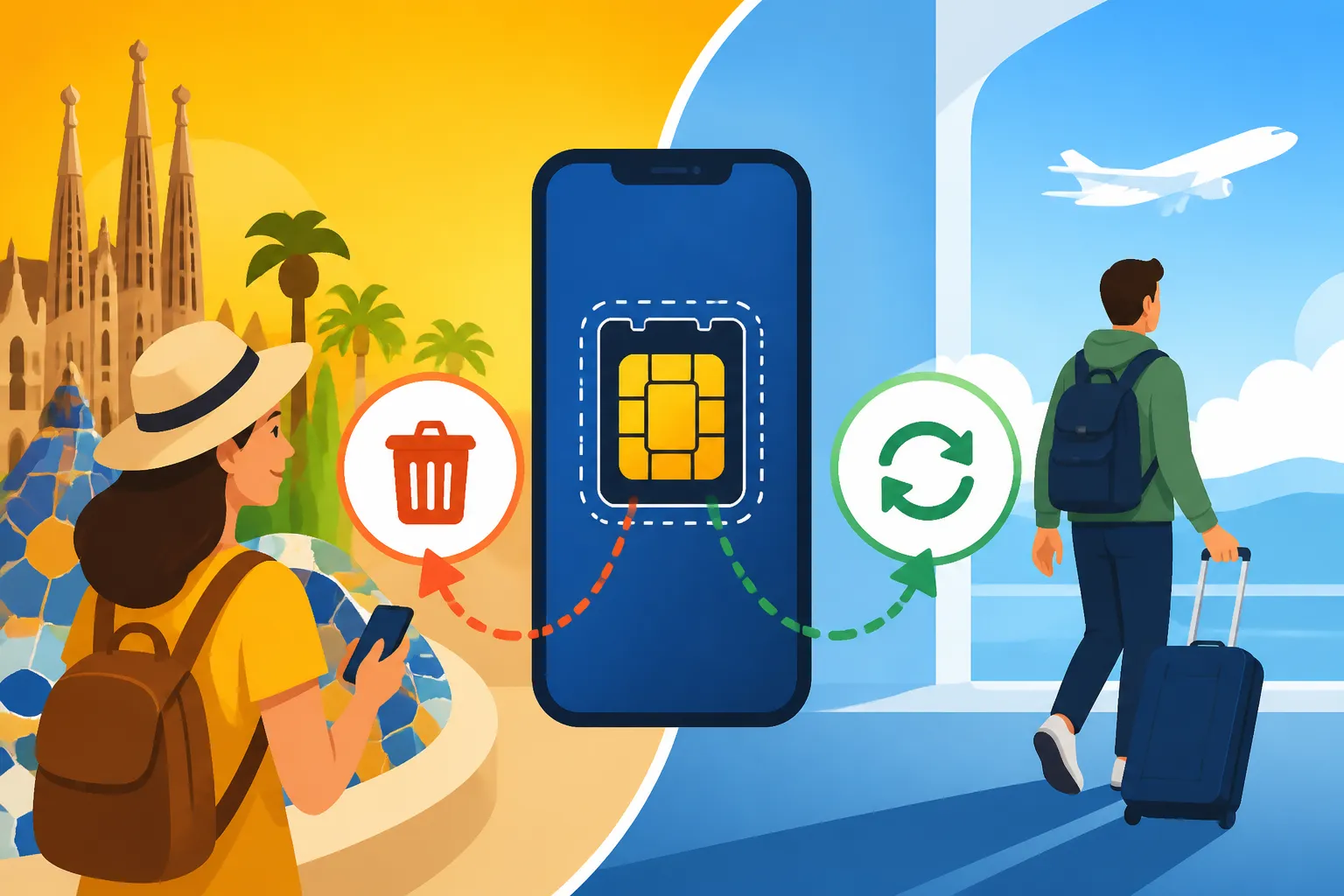
- When your data plan expires (either by data usage or validity period) or becomes geographically unusable: The data plan linked to your eSIM profile becomes inactive. You can no longer use it for internet access. However, the eSIM profile itself remains installed on your phone. It doesn't magically vanish.
- Keeping the profile: You don't have to delete the expired eSIM profile immediately. Many people choose to keep it. Why? Because if you use a provider that offers top-ups or new plans for the same region or country, you can often simply purchase a new plan and link it to the existing profile. This avoids the hassle of re-scanning a QR code or going through the installation process again. This is particularly convenient if you frequently travel back and forth from Spain or use a regional provider like Airalo.
- Deleting the profile: If you're absolutely certain you won't need that specific eSIM profile again – perhaps it was a one-off plan from a provider you disliked, or you prefer a clean slate – you can certainly delete it from your phone's settings. Just go to Settings > Cellular (or Mobile Data) > then find your eSIM profile and select "Remove Cellular Plan" or "Delete eSIM." This frees up space (digitally speaking, it's tiny) and removes clutter from your phone's list of cellular plans. It’s always good to keep your digital life as organised as your physical one!
Understanding this difference between the plan and the profile can help you manage your connectivity more efficiently, especially for your future travels outside of Spain.
Reusing Your eSIM (or Getting a New One) for Future Travel
The beauty of living abroad is the opportunity to explore, and that often means hopping across borders. The last thing you want is to be caught without data when you land in a new country. Let's talk about smart strategies for staying connected after your Spanish adventure.
To Delete or Not to Delete? Managing Your eSIM Profiles
We've covered that your eSIM profile remains on your phone even if its associated data plan expires or becomes geographically inactive. Now, what's the best practice for managing these digital ghosts?
Honestly, there's no hard and fast rule, but for us seasoned expats, usually, it's better to keep the eSIM profile unless you have a compelling reason to delete it.
Here's why:
- Potential for Reuse: Many eSIM providers, especially those offering regional or multi-country plans like Airalo, allow you to "top up" or purchase new data packages for an existing eSIM profile. Imagine you had an Airalo Europe plan for your travels. Even if that plan expired, the Airalo eSIM profile stays on your phone. When you plan your next trip to, say, Italy and Germany, you can simply go into the Airalo app, buy a new European data package, and assign it to your existing Airalo profile. Boom! Connected, no reinstallation required.
- Convenience for Frequent Travelers: If you often return to Spain or travel frequently within a specific region (like the EU), keeping a relevant eSIM profile means less fumbling with QR codes or manual installations each time. It simplifies the process immensely.
- No Real Downside: An inactive eSIM profile takes up virtually no storage space on your device, nor does it consume battery. It just sits there, patiently waiting for its next assignment. The only reason to delete it is if your list of cellular plans becomes unmanageably long or if you're sure you'll never use that specific provider or region again.
To delete, navigate to your phone's settings: for iPhones, it's typically under "Cellular" or "Mobile Data," and for Android, it's often "Network & internet" then "SIMs" or "Mobile network." Find the eSIM profile you want to remove and tap "Remove Cellular Plan" or "Delete eSIM." Just make sure you're deleting the right one!
The Smart Way Forward: Regional and Global eSIMs (Airalo is the Hero)
Here’s where the real magic happens for those of us who love to explore beyond Spain’s borders. While a country-specific eSIM is great for a focused stay, it quickly becomes a hindrance when you're touring around Europe or even heading further afield. This is why I always tell fellow expats about Airalo – it's truly been my go-to solution for seamless, stress-free connectivity while on the move.
Airalo offers a fantastic alternative: regional and global eSIM plans. Instead of buying a Spain-only eSIM, you can get a "Eurolink" plan from Airalo that covers dozens of countries across Europe. This means you can travel from Spain to France, then on to Germany, Italy, and beyond, all without ever worrying about losing your data connection or swapping SIMs.
The convenience is unparalleled. Before you even leave Spain, you can download the Airalo app, browse their extensive list of countries and regions, pick a plan that suits your next adventure – maybe a 10GB Europe plan for 30 days – purchase it, and install the eSIM profile. Then, the moment you land in your next destination, you just switch on that Airalo profile, and bam! Instant data. No frantic searching for Wi-Fi, no local SIM card hustles, no exorbitant roaming fees from your Spanish provider.
What's more, Airalo allows you to keep your primary Spanish physical SIM active for calls and texts if you need to, while using the Airalo eSIM purely for data. This dual-SIM functionality is a lifesaver. It gives you the best of both worlds: local number continuity and global data freedom. For any questions about managing your existing phone setup, our article on Mobile Phone Plans in Spain: Prepaid vs Contract for Foreigners could offer relevant context for local options.
Seriously, if you travel often, Airalo is the hero you need in your digital life. It's affordable, reliable, and takes one huge headache out of international travel planning.
Planning for Your Next Adventure: Pre-Departure eSIM Strategy
The key to seamless connectivity isn't just knowing what an eSIM does, but how to integrate it into your travel routine. For us expats in Spain who love to travel, a little pre-departure planning goes a long way.
Here's my tried-and-true strategy:
- Anticipate Your Needs: Before you even book your flights from Spain, consider where you're going and for how long. Is it a single country outside the EU? A multi-country European tour? A hop across the pond? This will dictate whether you need a country-specific eSIM, a regional eSIM, or even a global plan.
- Download the Airalo App: This is your control center. Get it on your phone well before you travel. You can browse plans, read reviews, and understand your options without pressure.
- Choose Your Plan Wisely (Hello, Airalo!): For most European travels, an Airalo Eurolink plan is usually the most efficient and cost-effective. For further-flung destinations, they have individual country plans or even global options. Pick the data amount and validity that matches your trip duration and usage habits.
- Purchase and Install Before You Go: The absolute best time to buy and install your eSIM is before you leave Spain. You can do it from the comfort of your home, using your stable Wi-Fi connection. The installation process is typically a quick QR code scan or a few manual steps through the Airalo app. This means you land in your new destination already connected.
- Activate Upon Arrival: Most eSIM plans only activate when they connect to a supported network in the destination country. So, once your plane touches down, you simply switch on the Airalo eSIM line in your phone settings, and you're good to go. No more scrambling for airport Wi-Fi to message loved ones or check directions!
This proactive approach, particularly with a reliable provider like Airalo, completely eliminates the stress of getting connected abroad. It gives you immediate access to maps, translation apps, ride-sharing services, and communication with friends and family, right from the moment you step off the plane. It’s peace of mind wrapped up in a tiny digital package. For other travel preparations, you might find our guide on Spain Visa Checklist: What to Do Before You Fly useful, though remember, as a resident, many visa concerns are already behind you! And if you're traveling with little ones, Family Travel in Spain: Kid-Friendly Cities and Activities offers some great tips.
Comparing eSIM Options for Post-Spain Travel
Let's break down the typical choices you'll face when leaving Spain and needing data, to highlight why regional or global eSIMs, especially from providers like Airalo, are often the smartest choice for expats and frequent travelers.
| Feature | Single-Country eSIM (e.g., Spain-only) | Regional/Global eSIM (e.g., Airalo Eurolink) | Traditional Roaming (with Spanish SIM) |
|---|---|---|---|
| Geographical Scope | Only works in the purchased country (e.g., Spain) | Works across multiple specified countries/regions (e.g., EU, Global) | Works wherever your provider has a roaming agreement (nearly global) |
| Cost | Generally low for local data within Spain | Very competitive; often cheaper than roaming per GB for multi-country travel | Can be extremely expensive, especially outside EU/specific plans |
| Convenience | Easy to set up for one country, but need a new one for each new country | Buy once, use in many countries; easy top-ups | Your existing SIM just works, but often with bill shock |
| Activation | Instant upon arrival in specific country | Instant upon arrival in any covered country | Automatic |
| Keeping Primary SIM | Yes, excellent for dual-SIM setup (local calls + eSIM data) | Yes, excellent for dual-SIM setup (local calls + eSIM data) | Your primary SIM is used for everything |
| Best For | Extended stay in one country only | Frequent travel across multiple countries or regions | Emergency use, or if your Spanish provider offers affordable EU roaming plans |
As you can see, for anyone venturing beyond Spain's borders frequently, a regional or global eSIM like those offered by Airalo is generally the superior option. It combines the convenience of immediate connectivity with cost-effectiveness, sidestepping the headaches of managing multiple single-country plans or dreading a massive roaming bill. This approach is definitely a favorite among expats who want to explore without constant connectivity worries. If you want to dive deeper into broader travel logistics, check out Travel Logistics in Spain: Money, Safety, and Connectivity.
Disclaimer
Please remember that while I strive to provide accurate and up-to-date information based on my experience and available data, regulations and offerings (especially concerning telecommunications and travel) can change. Always verify the latest terms and conditions directly with eSIM providers or relevant authorities before making decisions. This guide is for informational purposes only and does not constitute professional advice.