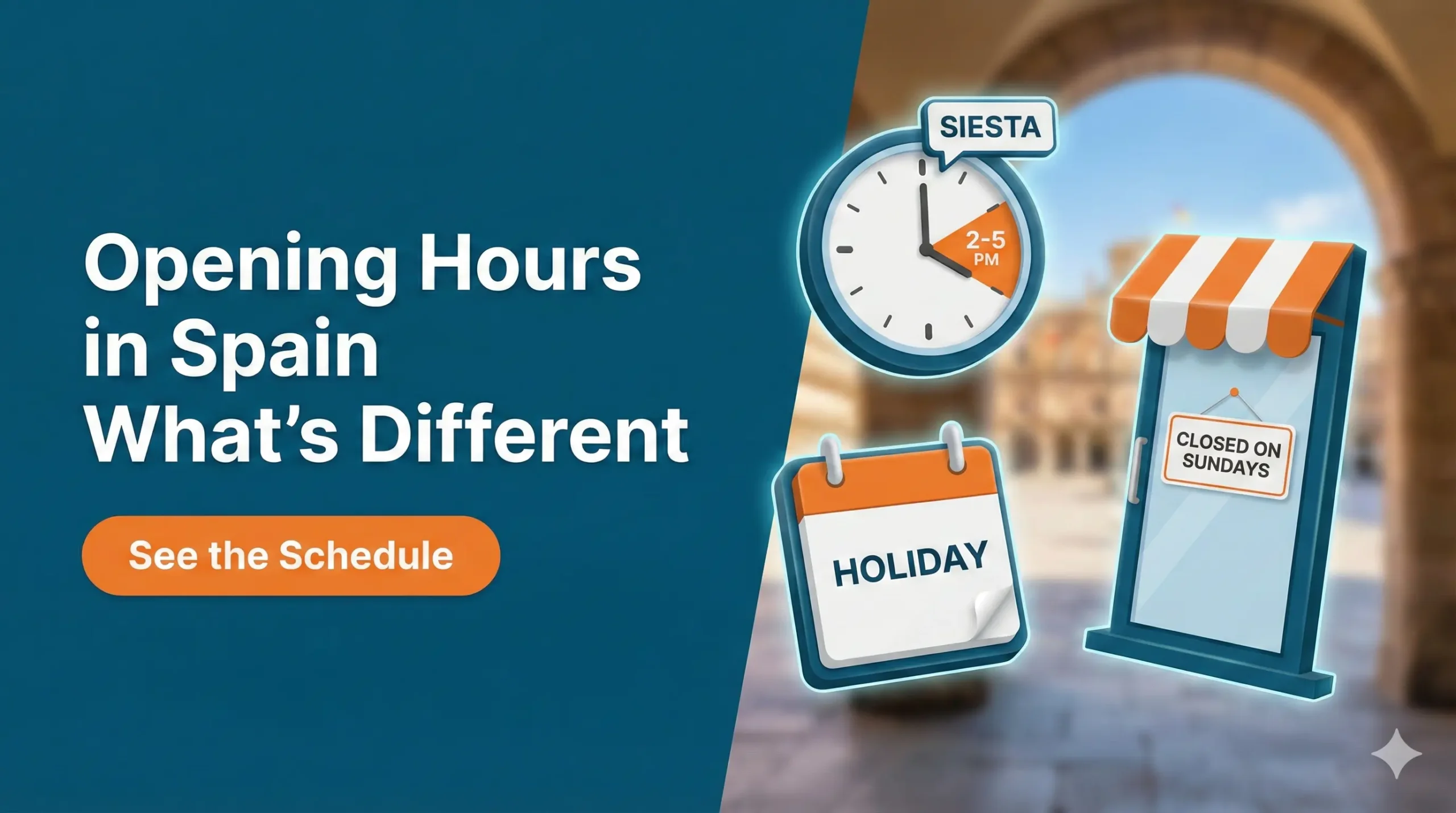
Opening Hours in Spain: What’s Different (Siesta, Holidays, Sundays)
Disclosure: This article contains affiliate links. If you buy through them, we may earn a commission at no extra cost to you. Read our full disclosure.
Adjusting to Spanish opening hours requires a complete mindset shift. This comprehensive guide decodes the realities of the afternoon siesta, regional Sunday shopping bans, unexpected public holiday closures, and the surprisingly early closing times of banks and public administration offices.
The Myth and Modern Reality of the Spanish Siesta
The most globally recognized—and frequently misunderstood—aspect of Spanish culture is the siesta. Foreign media often paints a romanticized picture of an entire nation putting on their pajamas and taking a collective two-hour nap in the middle of the afternoon. While resting is certainly part of the culture, the modern siesta is much more about the structure of the working day than it is about sleeping.
The Historical Context
The word siesta derives from the Latin hora sexta, referring to the sixth hour after dawn, which lands squarely at midday. Historically, Spain was a heavily agrarian society. In regions like Andalusia, Extremadura, and Castilla-La Mancha, summer temperatures frequently exceed forty degrees Celsius (over one hundred degrees Fahrenheit). Working in the fields during the peak afternoon heat was physically dangerous. The logical solution was to wake up at dawn, work until early afternoon, retreat indoors during the hottest hours to eat the main meal and rest, and then return to the fields in the cooler early evening.
The Split Shift or Jornada Partida
Today, the vast majority of Spaniards work in air-conditioned offices, shops, and service industries, but the cultural rhythm remains deeply entrenched through the jornada partida, or split working shift.
Rather than working a continuous eight-hour day with a brief thirty-minute sandwich break at their desks, many Spanish employees work from 9:00 AM until 2:00 PM. They then take a massive two to three-hour break. During this time, they commute home, eat a large, multi-course lunch with their families, relax, run personal errands, and then return to work around 5:00 PM, finishing their day between 8:00 PM and 9:00 PM.
This is why the streets suddenly empty out in the early afternoon. The local shopkeepers are not necessarily napping; they are simply having their lunch and living their personal lives. It is important to note that this means the average Spanish worker actually has a significantly longer overall workday, finishing much later in the evening than their European counterparts.
The Urban Versus Rural Divide
The strict observance of the siesta break depends heavily on where you are. In massive global metropolises like Madrid and Barcelona, the corporate world is slowly shifting toward a continuous European schedule to align with international markets. However, in mid-sized cities, coastal towns, and rural villages, the afternoon shutdown is absolute and universally respected.
Standard Retail and Supermarket Hours
When planning your shopping trips, you must divide the Spanish retail landscape into two distinct categories: large corporate chains and small independent businesses.
Large Chains and Supermarkets
If you need to shop during the afternoon siesta hours, you must head to the grandes superficies (large commercial areas). Massive national and international chains do not close during the afternoon.
- Supermarkets: Major grocery chains like Mercadona, Carrefour, Consum, ALDI, and Lidl typically open at 9:00 AM and remain open continuously until 9:30 PM. In the summer, many extend their hours to 10:00 PM.
- Department Stores: The iconic Spanish department store, El Corte Inglés, and major fashion retailers like Zara, H&M, and Primark operate on a continuous schedule, usually from 10:00 AM until 10:00 PM.
If you are currently setting up your new household and trying to calculate your grocery expenses across these different chains, you can review our detailed breakdown in the Cost of Living in Spain: Monthly Budget Guide for Expats.
Small Independent Businesses
The local lifeblood of Spain—the neighborhood butcher, the bakery, the hardware store (ferretería), the tailor, and the independent boutique—operates on the traditional split schedule.
- Morning Shift: They typically open their metal shutters at 9:30 AM or 10:00 AM and close promptly at 1:30 PM or 2:00 PM.
- Afternoon Shift: They remain closed for the entire afternoon, reopening around 5:00 PM or 5:30 PM, and finally closing for the night between 8:00 PM and 8:30 PM.
- Saturdays: On Saturdays, almost all small independent shops only open for the morning shift. If you need a specialty item from a local vendor, you must buy it before 2:00 PM on Saturday, or wait until Monday morning.
Dining Out and Spanish Meal Times
The most common trap tourists and newly arrived expats fall into involves the operating hours of Spanish restaurant kitchens. You cannot apply American or British dining times to Spain; if you try to eat dinner at 6:30 PM, you will be eating completely alone, or you will find the restaurant locked.
The Timeline of Spanish Meals
- Desayuno (Breakfast): 7:30 AM to 10:00 AM. Usually a light affair consisting of coffee, toast with crushed tomato and olive oil, or a croissant.
- Almuerzo (Mid-morning snack): 10:30 AM to 11:30 AM. A quick coffee and a small sandwich (bocadillo) to bridge the gap until the late lunch.
- Comida (Lunch): 2:00 PM to 4:00 PM. This is the main, heaviest meal of the day. This is precisely when the retail shops are closed for the siesta. Restaurants are packed during these hours serving the Menú del Día (a cost-effective, three-course set menu).
- Merienda (Afternoon snack): 5:30 PM to 7:00 PM. Often a sweet pastry or a piece of fruit, primarily for children finishing school, but enjoyed by adults as well.
- Cena (Dinner): 9:00 PM to 11:00 PM. The Spanish eat dinner incredibly late. Most high-quality restaurant kitchens do not even turn their stoves on for dinner service until 8:30 PM at the earliest.
The Kitchen Closure Danger Zone
Here is the crucial rule: between 4:30 PM and 8:00 PM, almost all restaurant kitchens in Spain are closed. While the bar itself might be open serving beer, wine, coffee, and pre-made cold tapas (like potato chips or slices of cured ham), you cannot order a hot meal. If you miss the 4:00 PM lunch window, you will have to wait until 8:30 PM to eat hot food, unless you resort to an international fast-food chain. To avoid culinary faux pas and seamlessly integrate into the local dining culture, read our comprehensive overview of Spanish Dining Etiquette and Tipping Culture.
Sunday Shopping Laws Region by Region
In many countries, Sunday is a prime day for running errands, visiting shopping malls, and stocking up on groceries for the week. In Spain, Sunday is fiercely protected as a day of rest, family time, and leisure.
As a general national rule, commercial trading on Sundays is strictly prohibited. If you need milk, bread, or a new shirt on a Sunday, you will generally find the supermarkets and shopping malls completely shuttered.
However, the regulation of Sunday commerce is delegated to the individual Autonomous Communities, resulting in a highly fragmented legal landscape. Some regions strictly enforce the Sunday ban, while others have completely deregulated their markets to cater to tourism.
Exceptions to the Sunday Rule
Even in the strictest regions, there are a few universal exceptions. Bakeries, florists, pharmacies on emergency duty, petrol stations, and shops located inside airports or major train stations are permitted to open.
Furthermore, you will find small convenience stores—colloquially and historically referred to in Spain as chinos because they are frequently owned by Chinese immigrant families—open on Sundays. These small shops are the ultimate lifesaver for expats, selling everything from emergency toilet paper and bottled water to basic pantry staples and charging cables, often remaining open until midnight, seven days a week.
Areas of Great Tourist Influx
To balance the protection of retail workers with the demands of the massive Spanish tourism industry, the government created the designation of Zonas de Gran Afluencia Turística (ZGAT). If a municipality or a specific neighborhood receives this designation, large stores and shopping malls within that zone are permitted to open on Sundays during specific peak tourist seasons.
Summary of Sunday Shopping Rules by Region
| Autonomous Community | Sunday Trading Law | Key Exceptions and Notes |
| Madrid | Fully Deregulated | All shops, including large supermarkets and malls, can open 365 days a year. |
| Catalonia (Barcelona) | Strictly Regulated | Closed on Sundays. Only allowed to open on roughly 10 specific state-approved Sundays per year (mostly during Christmas and summer sales). |
| Andalusia | Heavily Regulated | Closed on Sundays. However, designated coastal tourist zones (Malaga, Marbella, Estepona) can open on Sundays during the summer (June to September) and Easter week. |
| Valencian Community | Regulated with Exceptions | Closed on Sundays. Coastal tourist areas (Alicante, Benidorm) have summer exemptions similar to Andalusia. |
| Basque Country | Strictly Regulated | Almost universally closed on Sundays to protect small businesses and union rights. |
Public Holidays and the Famous Puente
Spain enjoys a generous number of public holidays, known as festivos. On a red-letter public holiday, the entire country shuts down. Banks, offices, supermarkets, retail stores, and schools are closed. Only emergency services, public transport (on a reduced schedule), and hospitality venues (bars and restaurants) remain open.
The Three Tiers of Holidays
The holiday calendar in Spain is complex because it operates on three overlapping tiers:
- National Holidays: Celebrated across the entire country (e.g., Christmas Day, New Year’s Day, Labor Day on May 1st, Hispanic Day on October 12th).
- Regional Holidays: Specific to the Autonomous Community (e.g., Andalucia Day on February 28th, La Diada in Catalonia on September 11th).
- Local Holidays: Every single municipality, town, and village has its own specific patron saint days. On these days, your specific town shuts down, even if the town five kilometers down the road is operating normally.
The Concept of the Puente (The Bridge)
When a public holiday falls on a Tuesday or a Thursday, the Spanish engage in a cherished cultural practice known as hacer puente (making a bridge).
If a holiday is on a Thursday, many businesses, schools, and offices will also close on Friday, creating a massive four-day weekend. The most famous of these occurs in early December. Constitution Day is December 6th, and the Immaculate Conception is December 8th. If these fall on a Tuesday and Thursday, the entire country essentially shuts down for a full week, known as a macro-puente.
For expatriates, these bridge weekends can cause massive disruptions if you are trying to handle urgent paperwork. Government offices will be closed, and processing times will grind to a halt. If you are navigating the complex immigration system, you must consult the local holiday calendar before planning your appointments. Ensure you understand the timeline of these procedures by reading our guide on Getting an NIE for Employment or Study.
Bank and Public Administration Hours
One of the most jarring administrative hurdles for a newly arrived expatriate is the operating schedule of Spanish financial institutions and government offices.
Spanish Banking Hours
Unlike in the United Kingdom or the United States, where high street banks remain open until 5:00 PM and often have Saturday morning hours, Spanish banks operate on a strictly morning-only schedule.
Major banks like Santander, BBVA, and CaixaBank generally open to the public at 8:30 AM and close their doors permanently for the day between 2:00 PM and 2:30 PM. There are absolutely no afternoon banking hours, and they are completely closed on weekends. If you need to speak to a teller, resolve a blocked account, or deposit a physical check, you must take time off work in the morning to do so. To ensure you have all your paperwork perfectly prepared before you wait in line, review our walkthrough on Setting Up a Spanish Bank Account for Rent and Bills.
Public Administration and Cita Previa
Dealing with the Spanish government—whether you are registering your address at the Town Hall, applying for a residency card at the Extranjería (Immigration Office), or registering a vehicle—requires extraordinary patience and adherence to the morning schedule.
Public administration offices generally operate from 9:00 AM to 2:00 PM, Monday through Friday.
Crucially, since the COVID-19 pandemic, the era of simply walking into a government office and taking a paper ticket is entirely over. Almost every single administrative procedure in Spain now requires a Cita Previa (a mandatory prior appointment) booked online days or weeks in advance. Security guards will not let you through the front door of the building without seeing proof of your confirmed digital appointment. Navigating this digital appointment system is a rite of passage for all expats; you can master the process by consulting Spanish Bureaucracy for Daily Life: Padrón, IDs, and Local Services.
Pharmacies and Emergency Hours
Spanish pharmacies (farmacias) are easily identifiable by the large, illuminated green crosses protruding from their storefronts. They are private businesses, but they operate under strict government concessions.
Generally, local pharmacies follow the traditional split shift of small retail businesses: opening from 9:30 AM to 2:00 PM, and again from 5:00 PM to 8:30 PM. However, medical emergencies do not respect the siesta or the Sunday shopping bans.
To ensure the public always has access to vital medication, Spanish towns operate a rotating emergency system known as the Farmacia de Guardia (On-Duty Pharmacy).
By law, a certain number of pharmacies in every district must remain open twenty-four hours a day, including Sundays and major public holidays. If you arrive at your local pharmacy and find the shutters down, look at the front door or the window. They are legally required to post a printed list (or a digital screen) displaying the exact name and address of the nearest Farmacia de Guardia that is currently open.
Conclusion: Adapting to the Spanish Pace
The initial frustration of encountering locked doors at three in the afternoon or finding the supermarket dark on a Sunday morning is a universal expatriate experience. It requires a complete rewiring of your internal logistical clock.
However, once you adapt to the rhythm, the benefits become profoundly clear. The Spanish opening hours are designed to protect the very things that make living in Spain so desirable: extended time with family, unhurried meals, the survival of diverse small neighborhood businesses, and a staunch refusal to let consumerism completely dominate human existence.
Learn to run your administrative errands early in the morning, buy your fresh produce before the afternoon heat sets in, and embrace the fact that the hours between two and five in the afternoon are meant for resting, eating, and simply existing. Adjusting your watch to the Spanish pace is not a sacrifice; it is the ultimate upgrade to your quality of life.
References
Primary sources official
- Boletín Oficial del Estado (BOE) – Commercial Hours Legislation: https://www.boe.es/
- Ministerio de Trabajo y Economía Social (National Holiday Calendar): https://www.mites.gob.es/
- Comunidad de Madrid (Business Hours and ZGAT Declarations): https://www.comunidad.madrid/
Other helpful sources
- Andalucia.com (Sunday Shopping Laws and Exceptions): https://www.andalucia.com/living/shopping-centres/sundays
- ThinkSPAIN (Public Holidays and Puentes Explained): https://www.thinkspain.com/information/living-in-spain/public-holidays-in-spain
Disclaimer
The information provided in this article is for educational and informational purposes only. Regional laws regarding Sunday trading (specifically the designation of Zonas de Gran Afluencia Turística) and the annual calendars for regional and local public holidays change frequently. We strongly recommend checking the official websites of your specific municipal Town Hall (Ayuntamiento) and local supermarkets for the most accurate and up-to-date operating hours in your immediate neighborhood.