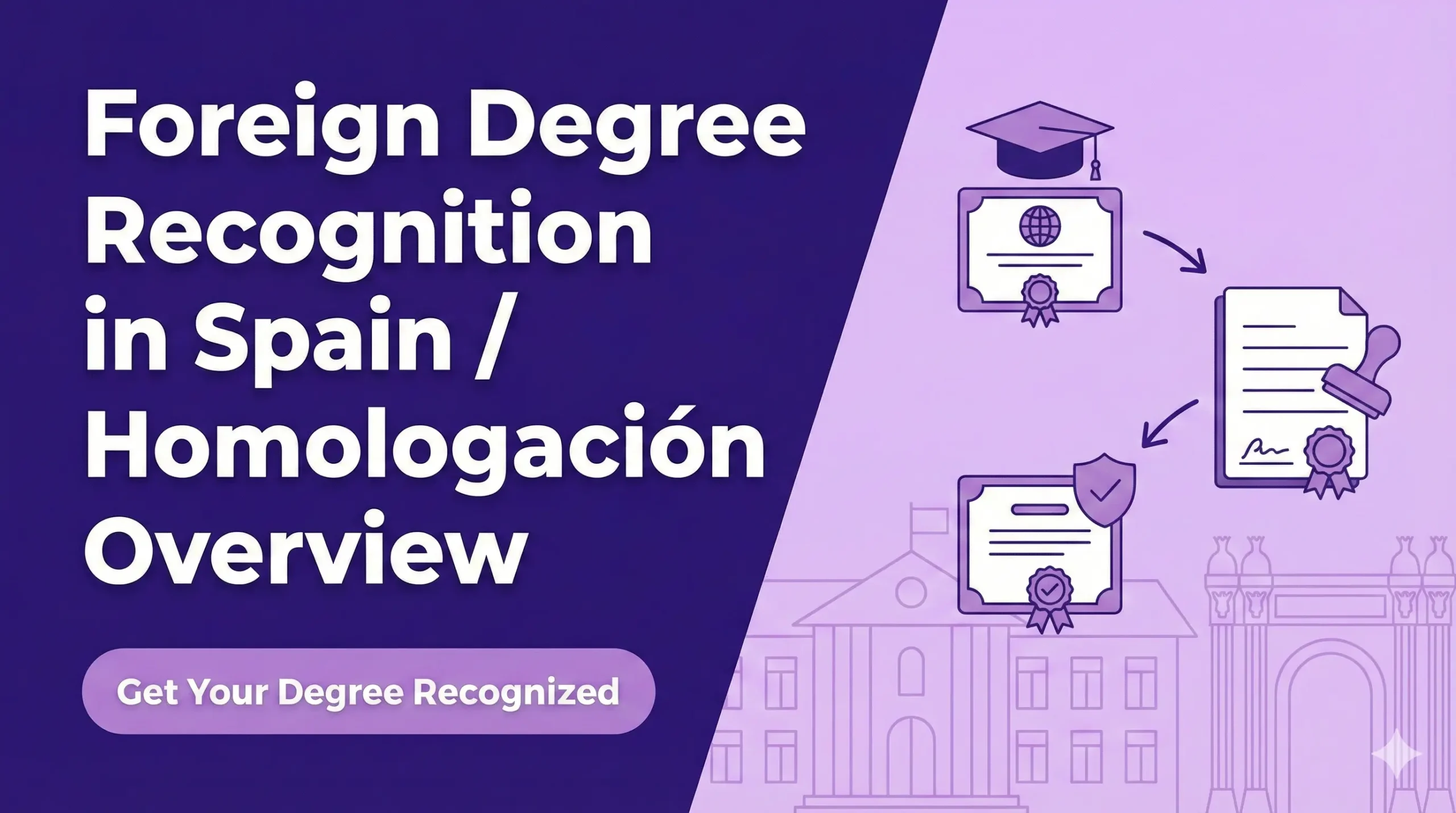
Recognition of Foreign Degrees (Homologación) in Spain: Overview
Navigating Spain’s foreign degree recognition system requires understanding the critical differences between homologation, equivalence, and convalidation. This comprehensive guide explains the exact steps to validate your academic credentials, the timeline for approval, and when you actually need it to work legally.
Disclosure: This post may contain affiliate links. We may earn a commission at no extra cost to you if you make a purchase through these links. Read full disclosure.
Introduction to the Spanish Academic Recognition System
The most common mistake expatriates make when moving to Spain is assuming that “homologación” is a blanket term for any type of degree translation, academic verification, or professional recognition. In reality, the Spanish Ministry of Universities operates a complex, multi-tiered system. Your chosen career path, your country of origin, and your specific university degree dictate exactly which of the three primary pathways you must take.
Applying for the wrong type of recognition will not only cost you hundreds of euros in non-refundable administrative fees but will also cost you months or even years of waiting, only to receive a rejection letter stating you applied for the incorrect procedure. Before you gather a single document or pay a single fee, you must accurately classify your professional intentions.

Differentiating Homologacion Equivalencia and Convalidacion
To successfully navigate the Spanish higher education bureaucracy, you must understand the deep legal distinction between these three distinct administrative procedures. Each serves a completely different purpose and grants entirely different rights upon approval.
The Homologacion Pathway
Homologation is the most rigorous, demanding, and legally powerful form of academic recognition available in Spain. It is the official, binding declaration by the Spanish Ministry of Universities that your foreign degree is completely equivalent to a specific, mandatory Spanish university degree that grants access to a “regulated profession.”
When you receive a favorable homologation resolution, the Spanish government is essentially stating that your international education matches the Spanish national curriculum so perfectly that you are legally authorized to practice your profession in Spain exactly as a native Spanish graduate would. This pathway is exclusively reserved for professions where the government mandates a specific university degree to protect public safety and welfare. The classic examples include medicine, dentistry, nursing, architecture, law, and civil engineering. If you hold a medical degree from the United States or Colombia, you must seek homologation to the Spanish title of “Licenciado en Medicina” before you can touch a patient.
The Equivalencia Pathway
Equivalence is a broader, slightly less stringent, and often faster form of academic recognition. It does not validate your degree to a specific Spanish professional title, but rather to a generic academic level within a specific branch of knowledge.
For example, if you hold a Bachelor of Arts in History from a university in the United Kingdom, you would apply for equivalence. The Spanish government will review your transcripts and certify that your degree is equivalent to a Spanish “Grado” (Bachelor’s level) in the general field of Arts and Humanities.
Equivalence is incredibly useful if you need to prove your academic level to access a Master’s degree or PhD program in a Spanish public university. Furthermore, it is the required pathway if you wish to apply for civil service jobs (public sector employment) that require candidates to hold a generic university degree to sit for the public examinations. It is also frequently utilized by professionals in unregulated fields who simply want official Spanish validation of their educational background to present to major corporate employers during the hiring process.
The Convalidacion Pathway
Convalidation has absolutely nothing to do with recognizing a completed degree for professional working purposes. Convalidation is the academic process of recognizing partial university credits.
If you started a university degree in your home country but did not finish it, and you wish to transfer to a Spanish university to complete your studies, you must apply for convalidation. You submit your foreign transcripts to the specific Spanish university you wish to attend, and their academic board decides which of your foreign subjects match their specific syllabus. They will then grant you local academic credits, allowing you to skip certain classes in Spain. This process is handled directly by the individual university’s admissions office, not by the central Ministry of Universities in Madrid.
Regulated Versus Unregulated Professions
The absolute deciding factor in whether you need to pursue homologation or equivalence rests entirely on whether your profession is classified as “regulated” or “unregulated” under Spanish national law. Understanding this divide will save you immense frustration.
Working in an Unregulated Profession
The vast majority of modern corporate, creative, and technological roles fall into the unregulated category. If you are a software engineer, a marketing director, a graphic designer, a business management consultant, a data analyst, or a public relations specialist, your profession is not heavily regulated by the state.
In these fields, the Spanish government does not legally mandate that you hold a specific university degree to perform the job or use the job title. The decision to hire you rests entirely with the private employer. They will evaluate your foreign degree, your professional experience, your technical skills, and your portfolio based on their own internal corporate standards.
If you work in an unregulated profession, you generally do not need to go through the grueling homologation process. You can begin applying for jobs immediately upon arrival. Your primary focus should be on localizing your resume for the Spanish market, mastering the language, and building your local professional network. You can optimize your approach by reviewing our comprehensive guide on Finding a Job in Spain: CV, Interviews, and Networking.
Working in a Regulated Profession
Regulated professions are those where the law explicitly dictates the academic qualifications and legal registrations required to practice. The primary justification is the unwavering protection of public health, structural safety, and consumer rights.
If you are a doctor, nurse, pharmacist, lawyer, architect, clinical psychologist, or public school teacher, your profession is heavily regulated. You cannot legally sign an official document, treat a patient in a hospital, or represent a client in a Spanish court without full, unconditional homologation of your degree.
Furthermore, homologation is only the first administrative step. Once the Ministry of Universities homologates your degree, you must then officially register with the corresponding professional board or chamber for your specific region before you can work. To understand how these mandatory governing bodies operate and the fees associated with them, read our detailed breakdown on Professional Colegios in Spain: Regulated Professions Explained.
The European Union Advantage in Professional Recognition
If you are a citizen of the European Union, the European Economic Area, or Switzerland, and you obtained your university degree within the EU, you benefit from a completely different and vastly superior legal framework compared to third-country nationals.
Due to the overarching European directives on the free movement of professionals and labor, EU citizens do not usually undergo the standard, lengthy homologation process. Instead, they apply for a streamlined process known as “Professional Recognition” (Reconocimiento Profesional).
Because EU universities operate under the standardized Bologna Process, the Spanish government inherently assumes your academic training is broadly equivalent to Spanish standards. The recognition process is significantly faster and is often handled directly by the specific ministry related to your profession (for example, the Ministry of Health for doctors and nurses) rather than getting bottlenecked at the Ministry of Universities.
For certain highly mobile professions like nursing, pharmacy, and physiotherapy, EU citizens can even use the European Professional Card (EPC), an entirely electronic procedure that accelerates recognition to a matter of mere weeks. If you hold a non-EU degree, unfortunately, these expedited European pathways are entirely closed to you, and you must follow the standard homologation route.
Step by Step Guide to the Homologacion Process
If you have determined that your non-EU degree requires full homologation to practice a regulated profession, you must prepare for a rigorous administrative journey. The process demands meticulous attention to detail. A single missing stamp or an improperly translated page can delay your application by six months.
Step One: Gathering Your Academic Documents
You cannot simply submit a photocopy of your diploma. The Ministry of Universities requires a comprehensive, exhaustive academic dossier to evaluate exactly what you studied, how long you studied it, and the depth of the material. You must obtain original, official copies of:
- Your official university diploma or degree certificate.
- Your complete academic transcripts, showing every single subject taken, the grades received, and the exact number of hours or academic credits awarded for each subject.
- The official syllabus or curriculum from your university, detailing the specific academic content, topics covered, and clinical hours (if applicable) in each subject during your years of study. This document can often be hundreds of pages long.
Step Two: Legalization and the Apostille of the Hague
A foreign public document has absolutely no legal validity in Spain unless it has been properly authenticated by international standards. You must legalize your diploma, your transcripts, and your syllabus before bringing them to Spain or submitting them online.
If your home country is a signatory to the Hague Convention (which includes the United States, the United Kingdom, Australia, and most Latin American countries), this process is relatively streamlined. You must obtain an “Apostille of the Hague” for each document from your home country’s designated government authority (such as the Secretary of State in the US or the Foreign, Commonwealth & Development Office in the UK). If your country is not a signatory, you must undergo a complex chain legalization process involving your domestic Ministry of Foreign Affairs and the Spanish Embassy in your home country.
Step Three: Sworn Translations
The Spanish Ministry of Universities operates exclusively in Spanish. If your apostilled diploma, transcripts, and exhaustive syllabi are in English, French, Mandarin, Arabic, or any other language, they must be translated.
You cannot translate them yourself to save money, nor can you use a standard commercial translation agency. You are legally required to use a “Traductor Jurado” (Sworn Translator) who is officially certified and registered with the Spanish Ministry of Foreign Affairs. The sworn translator will stamp, sign, and date the translation, legally certifying its accuracy. Because you must translate everything, including the lengthy syllabus, this is often the most expensive step of the entire process.
Step Four: Securing Digital Identification
In recent years, the Spanish government completely digitized the homologation process under Royal Decree 889/2022. Physical, paper applications handed in at a registry office are no longer accepted for this procedure. You must submit your entire dossier electronically through the online headquarters (Sede Electrónica) of the Ministry of Universities.
To access this secure portal, you must possess a Spanish digital certificate (Certificado Digital) or be registered in the Cl@ve system. Securing this digital identity requires you to have a foundational administrative presence in Spain, including an address and an ID number. Ensure your local municipal registrations are complete by following the steps outlined in Spanish Bureaucracy for Daily Life: Padrón, IDs, and Local Services.
Step Five: Paying the Administrative Fee
Before you can click the final submit button on the electronic portal, you must pay the mandatory government processing fee, known as the Tasa 079. As of the current regulations in 2026, the fee is approximately 165 euros.
You can usually pay this fee directly through the government’s online payment gateway using a Spanish bank account, or you can download the payment form (Modelo 790), take it to a physical Spanish bank branch, pay in cash at the teller, and then upload the stamped receipt back to the portal. If you have not yet established your administrative right to hold a resident bank account or pay taxes, you may need to secure your foreigner identification number first. Review the prerequisites carefully in Getting an NIE for Employment or Study: Practical Overview.
Step Six: Submission and the Waiting Game
Once you have meticulously uploaded your scanned, apostilled, and sworn-translated documents alongside your proof of fee payment, you submit the application. You will immediately receive an electronic receipt with a tracking number (número de expediente). From this moment on, the only thing left to do is wait for the Ministry evaluators to review your file.
Understanding the Costs and Timelines
The homologation process requires a significant, unavoidable investment of both money and time. Expatriates must budget carefully for this phase of their relocation, as it directly impacts when they can begin earning a living in their chosen profession.
Financial Costs
While the government fee (Tasa 079) is relatively low, the hidden administrative costs accumulate rapidly. Obtaining original sealed transcripts from your university often carries a fee. Securing the Apostille of the Hague for hundreds of pages of academic records can be expensive.
However, the absolute largest expense is the sworn translation. Because certified translators charge per word or per page, translating a massive, four-year university syllabus can easily cost between 500 and 2,000 euros, depending on the length of the document and the language pairing. When planning your relocation budget, you must factor in these upfront administrative costs. For a broader perspective on managing your finances during your transition, consult our Cost of Living in Spain: Monthly Budget Guide for Expats.
Processing Timelines and Delays
This is universally the most contentious and frustrating aspect of the Spanish recognition system. Historically, achieving homologation could take up to three or even four years. In an attempt to modernize the system and attract foreign talent, the Spanish government passed a new law (Royal Decree 889/2022) mandating that the Ministry resolve homologation requests within a maximum of six months.
Unfortunately, the reality on the ground often fails to meet this legislative promise. Due to chronic understaffing at the Ministry and a massive, ongoing backlog of applications from around the world, processing times still frequently exceed twelve to eighteen months, particularly for highly complex medical, dental, and engineering degrees. You must factor this prolonged waiting period into your financial survival plan when moving to Spain, as you will absolutely not be able to practice your regulated profession until the final resolution is issued.
Dealing with Compensatory Measures
When the Ministry of Universities finally reviews your comprehensive dossier, they will issue one of three official resolutions: a favorable homologation, an outright denial, or a conditional homologation subject to compensatory measures.
The conditional homologation is incredibly common for non-EU degrees. The Ministry’s academic evaluators compare your foreign syllabus against the standard Spanish university curriculum line by line. If they determine that your foreign degree is generally equivalent, but you are missing specific, critical subjects that Spanish students are required by law to take, they will not grant you full recognition immediately.
Instead, they will require you to bridge the academic gap. You will be given a specific timeframe (usually a few years) to successfully complete “Compensatory Measures” (Medidas Compensatorias).
These measures typically take two forms:
- Aptitude Test (Prueba de Aptitud): You must register at a Spanish university and sit for formal, written or oral exams in the specific subjects you are missing.
- Practice Period (Período de Prácticas): You must complete a supervised internship or clinical rotation in a Spanish facility for a specified number of months to prove your practical competency and understanding of Spanish protocols.
You must pay the university fees out of pocket to take these exams or complete these practicums. Only after you successfully pass the compensatory measures and submit the official proof of completion back to the Ministry will they lift the condition and issue your final, unconditional homologation credential.
Impact on Work Visas and Employer Sponsorship
The homologation process is deeply and unavoidably intertwined with the Spanish immigration system. If you require employer sponsorship to obtain a work visa, the status of your degree recognition can make or break the job offer.
If a Spanish hospital, engineering firm, or law practice wishes to hire you for a regulated role, they cannot legally sponsor your work permit until your degree is fully homologated. The Spanish immigration authorities will categorically reject the work visa application if the mandatory academic credential is missing from the dossier.
Because the homologation process takes over a year, employers are generally unwilling to hold a job vacancy open for that long while you wait for the Ministry. Therefore, if you belong to a regulated profession, it is highly recommended that you initiate the homologation process from your home country long before you begin actively applying for jobs in Spain. You can apply digitally or through the Spanish consulate in your country of origin.
Once your degree is recognized, you become a highly attractive candidate on the local market, and employers can sponsor you quickly, often utilizing fast-track visa options designed for highly skilled workers. To understand how companies navigate this sponsorship process once your paperwork is finally in order, read our detailed overview on Spain Work Permits: High-Level Employer Sponsorship Flow.
Comparison of Spanish Academic Recognition Pathways
To quickly reference which administrative path applies to your specific situation, consult the following breakdown.
| Concept | Primary Purpose | Best Suited For | Access to Regulated Professions | Estimated Processing Time |
| Homologacion | Validating a foreign degree to a specific Spanish professional title. | Doctors, Lawyers, Architects, Nurses, Engineers, Teachers. | Yes (Absolutely Mandatory) | 12 to 24+ Months |
| Equivalencia | Validating a foreign degree to a generic academic level (e.g., Bachelor’s). | Corporate roles, accessing Masters/PhD programs, Civil Service exams. | No | 6 to 12 Months |
| Convalidacion | Recognizing partial university credits to continue studying. | University students transferring to a Spanish academic institution. | No | Handled directly by the individual University |
Conclusion
The recognition of foreign degrees in Spain is an undeniable bureaucratic gauntlet. It demands immense patience, meticulous organization of paperwork, and a steadfast willingness to navigate a highly rigid legal framework.
However, it is a necessary crucible for professionals seeking to practice their lifelong careers in regulated fields on the Iberian Peninsula. By correctly identifying whether you require homologation or equivalence, investing the financial resources to properly apostille and translate your exhaustive academic records, and mentally preparing for the prolonged processing timelines, you can successfully conquer this administrative hurdle.
Earning your homologation credential is more than just receiving a piece of stamped paper from a ministry in Madrid; it is the ultimate validation of your expertise. It unlocks the doors to Spain’s prestigious professional colleges, grants you the unassailable legal right to practice your life’s work on Spanish soil, and permanently integrates you into the fabric of the European professional community.
References
Primary sources (official)
- Spanish Ministry of Universities (Homologation and Equivalence Portal): https://www.universidades.gob.es/
- Boletín Oficial del Estado (Royal Decree 889/2022 on University Degree Recognition): https://www.boe.es/
- Ministerio de Asuntos Exteriores (Information on Legalization and Apostilles): https://www.exteriores.gob.es/
Other helpful sources
- ENIC-NARIC Network (Information on Academic Recognition across Europe): https://www.enic-naric.net/
- Citizens Advice Bureau Spain (Guide to Validating Qualifications): https://www.citizensadvice.org.es/
Disclaimer
The information provided in this article is for educational and informational purposes only and does not constitute formal legal, academic, or immigration advice. Administrative procedures, government fees (Tasas), and processing timelines for the homologation and equivalence of foreign degrees are subject to frequent changes by the Spanish Ministry of Universities and the central government. We strongly recommend consulting the official government portals or engaging a registered Spanish administrative agent (Gestor Administrativo) for professional guidance tailored to your specific academic background and nationality.