Using Translation Apps in Spain: What Works Best
Standing in a local Spanish pharmacy trying to describe a specific stomach ache while the line behind you grows is a special kind of expat hell. I once spent ten minutes miming a sizzling pan to a hardware store clerk in Granada because I completely blanked on the word for frying pan. This guide solves that frustration by identifying the most reliable translation apps for navigating life in Spain.
Disclosure: This post may contain affiliate links. We may earn a commission at no extra cost to you if you make a purchase through these links. Read full disclosure.
Why Translation Apps are Vital for Life in Spain
The reality of living in or visiting Spain is that while major hubs like Madrid and Barcelona have high levels of English proficiency in tourist areas, the moment you step into a local gestoría, a health center, or a neighborhood market, that safety net disappears. Spanish bureaucracy is notoriously complex, and even the most prepared expat can find themselves drowning in a sea of technical terms and rapid-fire dialogue.
Navigating Local Bureaucracy and Services
Spanish administrative tasks, from signing a rental contract to registering at the local town hall, require a high level of precision. When you are dealing with Spanish Bureaucracy for Daily Life: Padrón, IDs, and Local Services, a single mistranslated word can lead to hours of wasted time or a rejected application. Translation apps act as a bridge, allowing you to scan official documents on the fly and understand exactly what you are signing before the ink is dry.
In these high-stakes environments, relying on a basic dictionary isn't enough. You need tools that understand the difference between a "notification" and a "requirement." I have found that having a reliable app open during an appointment at the extranjería can provide a much-needed confidence boost. It allows you to double-check the officer's requests and ensures that you are providing the correct documentation for your specific residency type.
Social Integration and Everyday Interactions
Beyond the paperwork, the true magic of Spain lies in its social pulse—the "vida social." Whether you are trying to understand the nuances of Spanish Slang and Everyday Expressions for Visitors at a tapas bar or chatting with your neighbor about a package delivery, communication is the key to feeling at home. Without a digital assistant, these small but vital interactions can become sources of anxiety rather than opportunities for connection.
Using a translation app isn't just about literal word-for-word accuracy; it is about learning the rhythm of the language. Many modern apps now include pronunciation guides and regional variations, which are essential when you realize that the Spanish spoken in the heart of Seville sounds nothing like the Spanish you learned in high school. These tools help you transition from being a silent observer to an active participant in your local community.
The Top Translation Apps Tested on Spanish Soil
Not all translation apps are created equal, especially when it comes to the specific quirks of European Spanish (Castellano). Over years of living here, I have whittled down the massive list of available software to three main contenders that actually work in real-world scenarios.
Google Translate: The All-Rounder
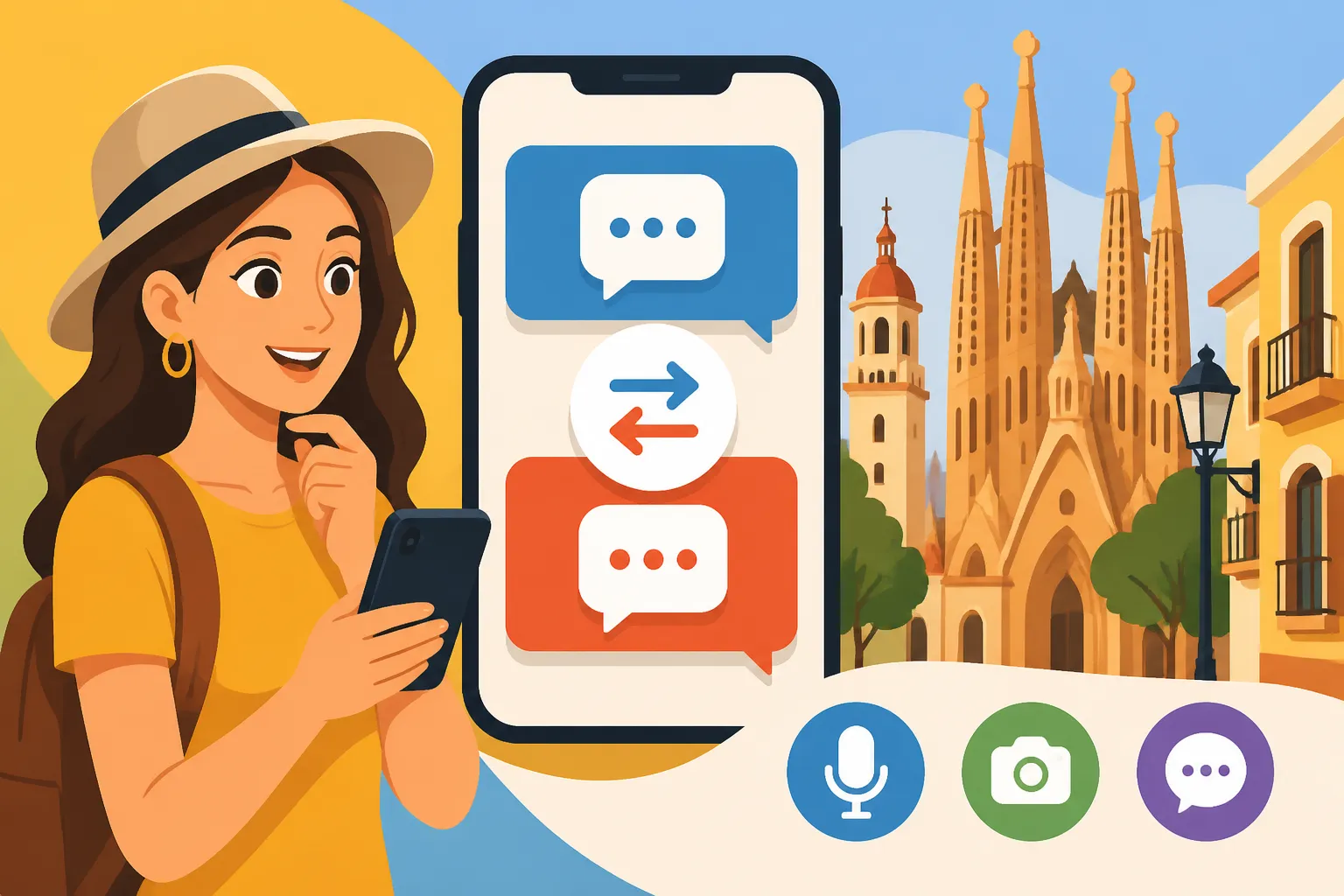
Google Translate remains the most versatile tool in the expat arsenal. Its greatest strength is the sheer variety of input methods. The "Conversation Mode" is particularly useful for those moments when you are speaking with someone who has a thick regional accent. It splits the screen in two, listening to both parties and providing an instant audio translation. When I first moved here, I used this constantly to communicate with my plumber, who spoke at approximately 100 miles per hour.
Another standout feature is the "Live Camera" translation. This is a lifesaver when you are staring at a complex menu or a utility bill. You simply point your phone at the text, and it overlays the English translation on the screen. It is also worth noting that Google Translate allows you to download the Spanish language pack for offline use. This is crucial when you are using Omio to navigate the high-speed rail network and find yourself in a tunnel or a rural station with no signal.
DeepL: The King of Nuance
If Google Translate is the generalist, DeepL is the specialist. Developed in Europe, DeepL’s AI is significantly better at capturing the formal and informal nuances of Spanish. In Spain, the distinction between tú (informal) and usted (formal) is vital. Using the wrong one can make you sound unintentionally rude or overly stiff. DeepL allows you to toggle between these tones, ensuring your emails to a potential landlord or a school administrator are pitch-perfect.
The translations produced by DeepL often feel more "human" and less robotic. It handles complex sentence structures with ease, making it the preferred choice for translating longer texts or professional correspondence. If you are trying to understand Spanish Medical Terminology: Common Words Expats Should Know before a doctor’s visit, DeepL will give you a much more accurate contextual translation than almost any other app on the market. It is my go-to for anything that requires a professional or highly accurate touch.
Microsoft Translator: Best for Group Conversations
While often overlooked, Microsoft Translator has a unique feature that is perfect for those awkward group settings. Its "Multi-Device Conversation" mode allows multiple people to join a chat via their own phones. Each person speaks their own language, and the app translates it into the language of every other participant. This is a game-changer if you are part of a neighborhood meeting or a community group where several nationalities are represented.
It also integrates beautifully with other Microsoft products, which can be helpful if you are working remotely in Spain. The interface is clean and offers a "Phrasebook" feature that covers common travel and emergency scenarios. This can be a great supplement to your Survival Spanish for Travelers: Key Phrases to Learn First list, providing quick access to essential sentences without needing to type them out every time.
Specialized Tools for Visual and Contextual Translation
Sometimes, a general translator isn't enough. You might find yourself in a situation where the visual layout of the text or the specific context of the conversation requires a more specialized approach.
Camera Translation for Menus and Bills
There is nothing more intimidating than a five-page Spanish menu with no descriptions. While many restaurants featured on GetYourGuide tours might provide English menus, the best local spots usually don't. Using the camera feature on Google Translate or specialized apps like Waygo can save you from accidentally ordering callos (tripe) when you wanted calamares (squid).
The trick to successful camera translation is lighting and stability. If you are in a dimly lit bodega, the app might struggle to recognize the characters. Pro-tip: take a photo of the menu first, then import it into the translation app. This often yields much higher accuracy than trying to hold your phone steady while the app live-translates. This is especially helpful for Ordering Food and Drinks in Spanish: A Practical Phrasebook users who want to verify specific ingredients due to allergies or preferences.
Dictation and Voice-to-Voice Real-Time Use
Voice translation has come a long way. The key to using it in Spain is to ensure you have selected "Spanish (Spain)" in the settings. There are subtle differences in vocabulary and pronunciation between Spain and Latin America that can confuse the AI. For example, the word for "car" in Spain is coche, while in many Latin American countries, it is carro.
When using voice translation, speak clearly and in short sentences. The more complex your grammar, the higher the chance the app will hallucinate a translation. I’ve found that using voice translation is most effective in one-on-one settings, such as at a post office counter or a pharmacy. If you are in a situation where you need more professional help, you might want to look into Medical Interpreters in Spain: Where to Find Help, but for daily errands, a voice-to-voice app is usually sufficient.
Comparative Analysis of Translation Features
To help you decide which tool to prioritize, I have compiled a comparison of the most important features for life in Spain.
| Feature | Google Translate | DeepL | Microsoft Translator |
|---|---|---|---|
| Accuracy (European Spanish) | Good | Excellent | Very Good |
| Offline Mode | Yes | Limited | Yes |
| Camera Translation | Excellent | No (Desktop/Web only) | Good |
| Voice Conversation | Excellent | No | Excellent |
| Tone (Formal/Informal) | Basic | Excellent | Good |
| Regional Dialect Support | Broad | Narrow | Broad |
Pro-Tips for Using Apps Without Looking Like a Tourist
One of the biggest hurdles for new arrivals is the fear of looking like a "guiri" (a slang term for a foreign tourist) while fumbling with a phone. The goal is to use these tools as a discreet aid, not a crutch that replaces human interaction.
Offline Access for Remote Villages and Trains
Spain is a country of incredible diversity, and some of its most beautiful spots have notoriously poor mobile reception. If you are traveling to a remote village in the Picos de Europa or taking a long train ride booked through Omio, you cannot rely on cloud-based translation. Always download the offline language files for your chosen app before you leave your house.
This isn't just about the words; it's about safety. If you find yourself in a situation where you need to communicate an emergency and have no bars, an offline translator is your only lifeline. It takes up very little space on your phone but provides immense peace of mind. I always keep Spanish, English, and a bit of French (for those trips across the border) downloaded on my device.
Combining Apps with Basic Spanish Phrases
The most successful expats are those who use apps to supplement their learning, not replace it. Start every interaction with a basic greeting like "Hola, buenos días" and a polite "Perdone, mi español es un poco limitado." This immediately builds rapport with the local person. Then, you can bring out the app to help with the more technical parts of the conversation.
This hybrid approach shows respect for the local culture and language. People are generally much more patient and helpful when they see you are making an effort. Use your app to look up specific words from Spanish Language and Everyday Communication for Visitors and then try to incorporate them into your speech. Over time, you’ll find yourself reaching for the phone less and less as your "muscle memory" for the language develops.
Common Pitfalls and How to Avoid Mistranslations
Language is a living thing, and apps don't always get the "vibe" right. There are several traps you should be aware of when relying on digital translation in Spain.
Regional Languages: Catalan, Basque, and Galician
Spain is a multilingual nation. If you are in Barcelona, Valencia, San Sebastián, or Santiago de Compostela, you will see signs and hear conversations in languages other than Spanish. While most residents are bilingual, understanding the local tongue is a sign of respect. Google Translate is decent at Regional Languages in Spain: Catalan, Basque, and Galician, but it can sometimes mix them up with Spanish in its suggestions.
When you are using Booking.com to find a place in Catalonia, for example, your host might message you in Catalan. Most apps will detect the language automatically, but be aware that the grammar and vocabulary are distinct. Don't assume that a Spanish translation will perfectly capture the sentiment of a Catalan message. If you are moving to one of these regions long-term, it is worth exploring dedicated apps for those specific languages.
Slang, Idioms, and Cultural Context
Spanish is a language rich in idioms that make absolutely no sense when translated literally. For instance, if someone tells you "No te compliques la vida," an app might tell you "Don't complicate your life," but in a social context, it often just means "Don't worry about it" or "Take it easy."
Apps struggle with the emotional weight of certain phrases. Spanish can be very direct, which can sometimes come across as rude in English translation. If an app translates a command as "Give me the bread," the person actually said "Dame el pan," which is a standard, non-rude way to ask for something in a Spanish bakery. Understanding the cultural context behind the words is just as important as the words themselves. Always cross-reference suspicious-sounding translations with a quick search of common Spanish Social Customs: Greetings, Kisses, and Personal Space to ensure you aren't misinterpreting the tone of the conversation.
Disclaimer
The information provided in this guide is for general informational purposes only. While every effort has been made to ensure accuracy at the time of writing, software features and regional language nuances can change. The author is not responsible for any misunderstandings, legal issues, or medical errors resulting from the use of translation apps. Always consult with a professional interpreter or a qualified local gestor for high-stakes administrative, legal, or medical matters.