How to Understand a Spanish Employment Contract Before Signing
Getting that first job offer in Spain is a moment of pure adrenaline, until the PDF lands in your inbox and you realize it is fifteen pages of dense legalese in a language you are still mastering. I remember sitting in a sun-drenched café in Valencia, staring at my first contract and wondering if I was accidentally agreeing to work every weekend for the next decade. This guide breaks down the essential clauses of a Spanish employment contract so you can sign with total confidence.
Disclosure: This post may contain affiliate links. We may earn a commission at no extra cost to you if you make a purchase through these links. Read full disclosure.
The Anatomy of a Spanish Employment Contract
Every official contract in Spain follows a relatively standardized format governed by the SEPE (Servicio Público de Empleo Estatal). Before you even look at the salary, you need to ensure the "Header" information is correct. This section, often titled "Las Partes," identifies the employer and the employee. As an expat, you must check that your NIE (Número de Identidad de Extranjero) is typed correctly. A single typo here can lead to massive headaches later when you try to register for healthcare or renew your residency.
The company details should include their CIF (tax ID) and their social security contribution code. Following this is the "Professional Category" or "Grupo Profesional." This isn't just a fancy title; it determines your minimum wage and your social security bracket. In Spain, duties are often grouped into categories (from 1 to 11), and if your contract places you in a group that doesn't match your actual responsibilities, you might be missing out on rights guaranteed by law. Understanding these categories is part of mastering Spanish Workplace Communication: Meetings, Feedback, and Tone because it sets the hierarchy of your role from day one.
Deciphering the Salary: Bruto vs. Neto
The most common trap for newcomers is the confusion between your gross salary (bruto) and what actually hits your bank account (neto). In Spain, job offers are almost always discussed in "Salario Bruto Anual." When you look at your contract, you will see a large number that looks fantastic, but you need to account for IRPF (income tax) and Social Security deductions.
Social Security is a fixed percentage, but IRPF is progressive and depends on your personal situation—whether you are married, have children, or have a disability. It is highly recommended to use a service like Taxes for Expats to model your actual take-home pay before you sign, especially if you are moving on a visa that has specific financial requirements. For a deeper dive into how these numbers look on paper, check out Spain Salary Expectations: How to Interpret ‘Bruto’ vs ‘Neto’ to avoid any end-of-the-month surprises.
The Pagas Extras Mystery: 12 vs. 14 Payments
One of the unique quirks of the Spanish labor market is the "Paga Extra" system. Traditionally, Spanish workers receive 14 payments per year: one every month, plus an extra full paycheck in June (for summer holidays) and December (for Christmas). However, many modern or international companies prefer to "prorate" these payments.
If your contract says your salary is "prorrateado," it means your 14 payments are divided by 12 and added to your monthly salary. You aren't earning more money; you are simply getting it evenly throughout the year instead of in two big lumps. This is a vital detail to confirm because it drastically changes your monthly budget. If you are trying to understand your first payslip once you start, our guide on What is ‘Nómina’? Understanding Spanish Payroll Documents will help you find where these extra payments are hidden.
| Feature | 14 Payments (Standard) | 12 Payments (Prorated) |
|---|---|---|
| Monthly Cash Flow | Lower monthly amount | Higher monthly amount |
| Bonus Periods | Full extra salary in June & Dec | No extra lump sums |
| Annual Total | Exactly the same | Exactly the same |
| Taxes | Distributed across 14 checks | Distributed across 12 checks |
Navigating the 2022 Labor Reforms
Spain underwent a massive labor reform in 2022 that fundamentally changed how contracts are issued. The goal was to reduce "precariedad" (precarious work) by making the permanent contract the default. Before this reform, many expats were stuck on a series of short-term "Obra o Servicio" contracts that could be terminated easily.
Today, you will likely see the term "Indefinido" on your contract. This means you are a permanent employee from day one. Even if the project you are working on is temporary, the law now pushes employers to use the "Fijo-Discontinuo" or "Indefinido" models. Understanding the nuances between these can be tricky, so I suggest reading Employment Contracts in Spain: Indefinite vs Temporary vs Training to see which legal protections apply to your specific situation. If your contract says "Temporal," make sure the reason for the temporality is clearly defined, or it may be legally invalid.
The Probation Period: Know Your Limits
The "Periodo de Prueba" is the window during which either you or the employer can walk away without notice or compensation. Many expats feel vulnerable during this time, but there are legal limits on how long this period can last. Generally, for qualified technicians (graduates), the limit is six months, while for other workers, it is two months (or three months in companies with fewer than 25 employees).
Check your contract to ensure the probation period doesn't exceed what is allowed by the How to Understand Probation Period Terms in Spain guidelines or your specific industry's collective agreement. If your employer tries to set a 12-month probation period for a standard office job, that is a major red flag. During this time, you should also be mindful of How to Handle Workplace Feedback in Spain Without Misunderstanding Tone so you can navigate the cultural expectations of your new office successfully.
The "Hidden" Rules: Collective Agreements
In Spain, your individual contract is only half the story. The real "bible" of your working conditions is the "Convenio Colectivo" (Collective Agreement). These are agreements negotiated between unions and employer associations for specific sectors (like IT, Hospitality, or Banking) or specific provinces.
Your contract must state which Convenio applies to you. This document covers everything from your minimum vacation days to how much you should be paid for overtime. If your contract says you have 22 days of vacation, but the Convenio says 25, the Convenio wins. It is often worth asking a colleague or searching online for the latest version of your sector's agreement. To understand how these massive documents impact your daily life, read up on What Is a ‘Convenio Colectivo’? How It Affects Your Job.
Working Hours and The Right to Disconnect
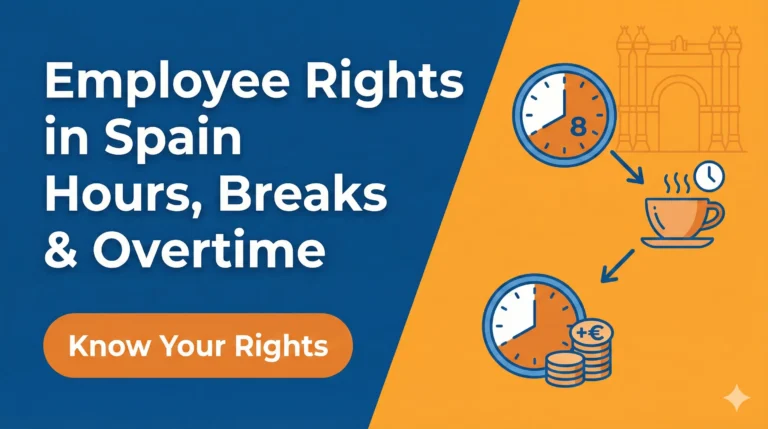
The "Jornada Laboral" section defines your hours. The legal maximum in Spain is 40 hours per week on average over a year. However, many expats are surprised by the "Intensiva" schedule during summer. Many Spanish companies allow employees to work from 8:00 AM to 3:00 PM during July and August to avoid the afternoon heat.
Furthermore, Spain has strict laws regarding the "Right to Digital Disconnection." Your employer generally cannot require you to answer WhatsApps or emails outside of your working hours. If you are a student moving to Spain, you have different restrictions on your hours, which we detail in How Many Hours Can Students Legally Work in Spain?. For everyone else, ensure your contract clearly states whether you are expected to work "Horas Extraordinarias" (overtime) and how those hours will be compensated—either with pay or time off.
Holidays and Time Off
Spain is generous with time off, but the way it is calculated can be confusing. You are entitled to a minimum of 30 calendar days (which includes weekends) or 22 labor days (only workdays) of vacation per year. Your contract will specify which method the company uses.
Beyond vacations, you have "Días de Asuntos Propios" (personal days) and "Permisos Retribuidos" for things like moving house (1 day), getting married (15 days), or the death of a family member. It is important to know the etiquette for requesting these. I recommend checking out How to Request Vacation Days in Spain: Etiquette and Timing to make sure you aren't asking for two weeks off during the busiest season of the year without realizing it.
Practical Preparation Before You Sign
If your Spanish is still at a "survival" level, do not sign the contract immediately. You have the right to take it home and review it. This is where a platform like iTalki can be a lifesaver—you can book a session with a professional Spanish teacher who specializes in business language to help you translate the specific jargon in your document.
If the legal language feels too risky to handle alone, you might want to look into How to Get a Work Contract Translated (and When You Should). Having a professional "Traductor Jurado" (sworn translator) look it over can provide peace of mind that there are no hidden "non-compete" clauses that could prevent you from taking a better job in the future.
When the Contract Isn't Enough: Going Autónomo
Sometimes, after reviewing a Spanish employment contract, you might realize the "Neto" pay isn't enough to sustain the lifestyle you want, or you prefer the flexibility of working for multiple clients. In these cases, many expats choose to forgo traditional employment and register as a freelancer.
Managing your own taxes can be daunting, but brands like Xolo make it incredibly simple by handling your registrations and quarterly filings for a flat fee. If you decide that being an employee isn't for you, our guide on Freelancing (Autónomo) in Spain: Taxes, Invoicing, and Setup Guide will walk you through the transition from a potential contract-holder to a business owner.
Termination and Notice Periods
Finally, look at the end of the contract. What happens if things don't work out? The "Preaviso" (notice period) is usually 15 days, but for high-level roles, it can be up to 3 or 6 months. If you leave without giving the required notice, the company has the right to deduct those days from your final paycheck (finiquito).
Similarly, understand "Indemnización" (severance). If you are fired for reasons that aren't your fault (Despido Objetivo), you are generally entitled to 20 days of pay per year worked. If the dismissal is found to be "Improcedente" (unfair), that number jumps to 33 days. These protections are a core part of the Spanish system, and they are what make the "Indefinido" contract so valuable compared to the gig economy models found elsewhere.
Spain Healthcare System for Expats: Public vs Private
A quick final note: once you sign that contract and your employer registers you with Social Security, you gain access to the public healthcare system. This is one of the biggest perks of working in Spain. You will need to take your signed contract and your "Alta en la Seguridad Social" document to your local health center to get your card. If you are curious about how this compares to the private insurance you might already have, check out our guide on Spain Healthcare System for Expats: Public vs Private.
Disclaimer
This guide is for informational purposes only and does not constitute legal or financial advice. Labor laws in Spain are subject to change, and collective agreements vary significantly by sector and region. Always consult with a qualified legal professional or a "gestor" before signing any legal documents.