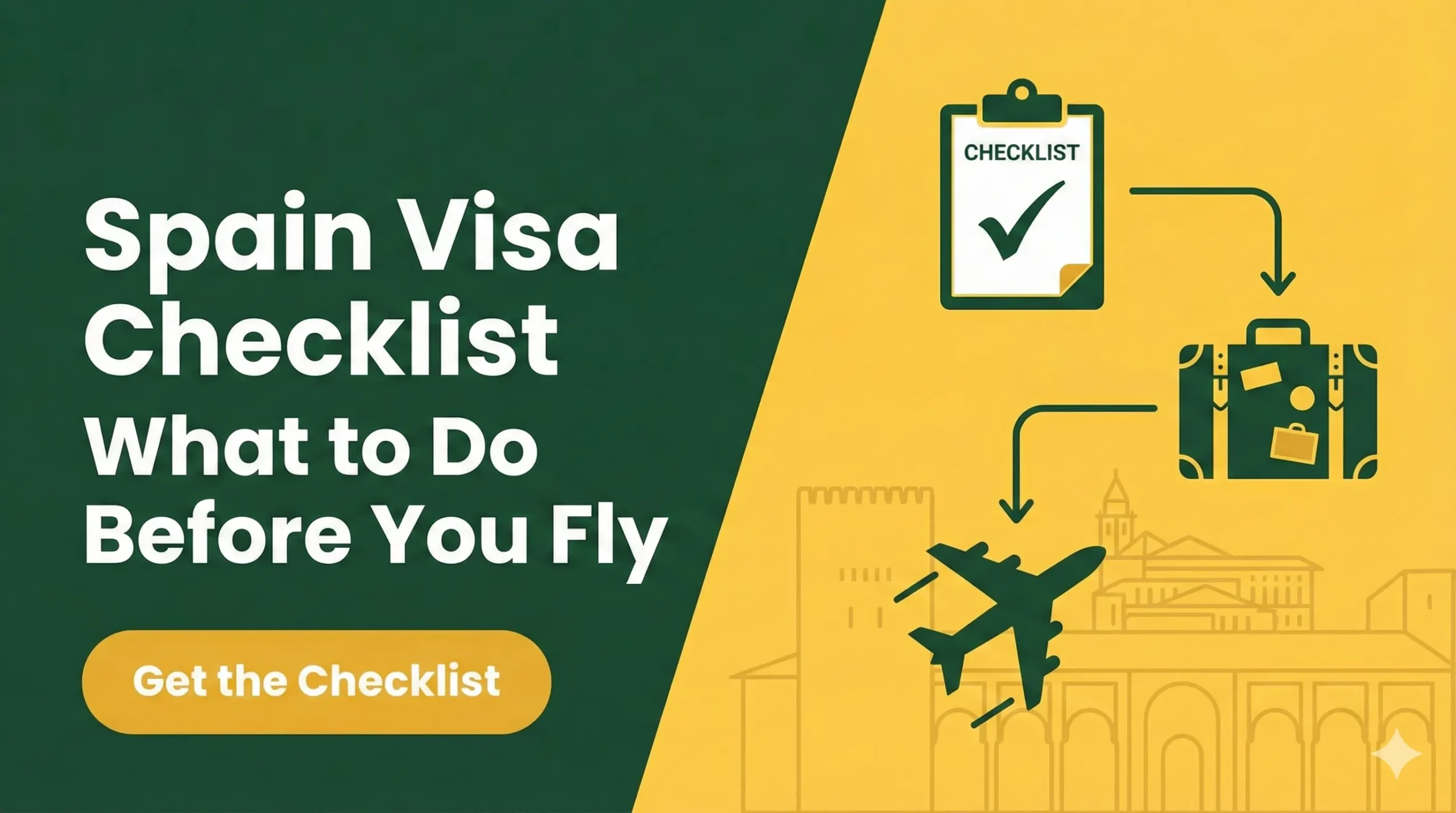
Spain Visa Checklist: What to Do Before You Fly
Disclosure: This article contains affiliate links. If you buy through them, we may earn a commission at no extra cost to you. Read our full disclosure.
Securing your visa is a major victory, but the work isn’t over yet. This comprehensive pre-departure guide covers every essential step between visa approval and your flight, ensuring you land in Spain with the right documents, finances, and peace of mind.
Verify Your Visa Details Immediately
Before you book a flight or hand in your notice at your current apartment, you must scrutinize the visa sticker itself. Consulates process thousands of applications, and human error is rare but possible. Catching a mistake now allows time for a correction, catching it at the airport check-in desk does not.
Check the validity dates carefully. Your visa will have a “Valid From” date. You cannot enter Spain on this visa before that date. If you enter early as a tourist (if your nationality allows), you may have to exit and re-enter the Schengen zone to “activate” the long-stay visa, depending on the specific type of permit you hold.
Ensure your NIE (Foreigner Identity Number) is printed on the visa if applicable. This number will stay with you forever in Spain, used for everything from taxes to receiving packages. Also, verify the spelling of your name matches your passport exactly. A single misplaced letter can cause issues with airline security or Spanish immigration officers who are strict about data matching.
If you are unsure about what specific codes on the sticker mean, or if the duration seems shorter than you expected (for example, many long-term visas are only issued as a 90-day entry permit initially), review the specifics of your permit type in our Spain Visas & Residency: Complete Guide for Foreigners.
Construct Your Master Immigration Folder
In a digital world, Spanish bureaucracy remains stubbornly analog. You will eventually need physical papers for your TIE card application (Foreigner Identity Card), your town hall registration (Padron), and potentially for banking. The most effective strategy is to create a physical “Master Immigration Folder” that stays in your carry-on luggage. Never check this bag.
Original Documents vs Copies
Your folder needs to be compartmentalized. First, gather every original document you submitted during your application. The consulate may have returned these to you, or you may have kept the originals while submitting copies. This includes your marriage certificates, birth certificates, and university degrees.
Crucially, ensure you have the original criminal record check with the Hague Apostille. Even though the consulate has already seen it, the immigration office in Spain often asks to see the original document again when you apply for your TIE card. If you only have a photocopy, you might be sent away to get a new one, which is a logistical nightmare from abroad.
Make high-quality color photocopies of everything. A good rule of thumb is “triples.” Have three copies of your passport data page, three copies of the visa page, and three copies of your insurance policy. You will hand these out like flyers during your first month in Spain.
Translations and Legalization
If your documents are not in Spanish, you likely used a sworn translator (traductor jurado) for your application. Ensure you have the original certified translations stapled to the original documents (or certified copies of them).
Check that the legalization (Apostille) is still intact. Sometimes, in the shuffling of papers, staples get removed or pages get torn. In Spain, a document that has been separated from its Apostille or sworn translation can sometimes be considered invalid by a strict functionary. For a refresher on which specific stamps you need to preserve, refer to our guide on Spain Visa Translations & Apostilles: What Needs Legalization?.
Financial Preparation for Arrival
Money management shifts drastically when you move across borders. You need access to funds immediately upon arrival for taxis, food, and emergency deposits, but you also need to prove your financial solvency to border agents if asked.
Carrying Cash and Customs Limits
You may feel safer carrying cash, but be aware of the limits. Any person entering the EU with €10,000 or more in cash (or equivalent in other currencies) must declare it to customs. This includes banker’s drafts and cheques of any kind. Failure to declare this can result in the money being seized and a heavy fine imposed.
Ideally, travel with a smaller amount of euros for immediate expenses—perhaps €200 to €500 in mixed denominations. Spain is largely card-friendly, but small cafes or rural taxi services might still prefer cash.
Banking Access and Cards
Before you fly, notify your home bank of your move. Even with modern fraud detection, a sudden flurry of transactions in Madrid or Barcelona can trigger a card block.
It is also vital to have a “bridge” banking solution. Traditional Spanish banks can be difficult to open accounts with until you have your physical TIE card, which can take weeks. Neo-banks or multi-currency accounts (like Wise or Revolut) are excellent for this interim period. Transfer a living allowance to these accounts before you fly so you can pay for groceries and transport immediately without incurring foreign transaction fees on your home bank card.
Proof of Funds for Border Control
Even though you already proved your finances to get the visa, the border guard has the legal right to verify you still meet the entry requirements. Keep a recent bank statement (printed within the last 5-7 days) in your Master Immigration Folder.
If you are on a Non-Lucrative Visa, this is especially important. You need to show you still have access to the funds you claimed. For details on exactly what these statements should look like to satisfy authorities, see Proof of Funds for Spain Visas: Accepted Bank Statements and Formats.
Health Insurance Validation
Your private health insurance policy was a requirement for the visa, but now you need to ensure it is operational for your arrival.
Check the start date on your policy certificate. It should align with your arrival date. If you delayed your flight, your insurance might already be active—which is fine. If you are arriving earlier than planned, you must contact your insurer to adjust the start date. You cannot be in Spain without coverage for even a single day.
Print the full policy document, not just the summary card. The border authorities or the immigration office for your TIE might want to see the clause stating “no copayments” (sin copagos) and “full coverage” (cobertura completa).
Familiarize yourself with the network of your insurer before you land. Download their app and look up the nearest hospitals and clinics to your temporary accommodation. Knowing exactly where to go in a medical emergency saves panic later. If you are unsure about the specific terms your policy must have, double-check against our article on Health Insurance for Spain Visas: Coverage Rules and Policy Checklist.
Accommodation Documents
You generally need a place to stay to enter the country, and you certainly need one to register for your residency card.
Temporary vs Permanent Housing
If you have already rented a long-term apartment, print the lease agreement. Ensure it is signed by both parties. If you are staying in temporary accommodation (Airbnb, hotel, or a short-term rental) while you look for a permanent home, print the booking confirmation showing the full address and dates.
Border agents need to know where you are sleeping. A vague answer like “I’m going to look for a flat in Valencia” can invite further scrutiny. Having a printed booking for your first 2-4 weeks shows stability and planning.
The Padron Prerequisite
Keep in mind that to get your TIE card, you need to register on the Padron (municipal register). Hotels generally do not allow this. If you are booking temporary housing, try to find a landlord who is willing to provide the necessary paperwork for the Padron, or prioritize finding a long-term rental quickly.
Digital Backups and Tech Prep
While paper is king in bureaucracy, digital backups are your safety net. Scan every single page of your Master Immigration Folder. Upload these scans to a secure cloud service (Google Drive, Dropbox, iCloud) and also email them to yourself and a trusted family member.
Phone and Connectivity
Arriving without data is a major handicap. You will need Google Maps to find your apartment and WhatsApp to communicate with landlords or drivers.
Check if your current phone is unlocked. If it is, you can buy a Spanish SIM card at the airport, though these are often more expensive “tourist” plans. A better option might be an eSIM which you can purchase and set up a few days before you fly, activating it the moment you land.
Download essential Spanish apps before you leave high-speed Wi-Fi:
- WhatsApp: The absolute standard for communication in Spain.
- Google Translate / DeepL: Essential for reading signs and menus.
- Cabify / Uber / FreeNow: For transport.
- Idealista / Fotocasa: For house hunting.
Photos for the TIE Application
You might think the photos you submitted for the visa are enough, but you will need new ones for the TIE card application. Spain has specific size and background requirements (carnet size, white background) which differ from US or UK passport standards.
While you can get these done in Spain at photo booths (fotomaton) or photography shops, getting them done before you fly (if you can find a studio that knows Spanish specifications) removes one errand from your busy first week. If you choose to do this, ensure they adhere strictly to the rules. A rejected photo means a rejected TIE application appointment. Learn the exact dimensions in Spain Visa Photo Requirements: Size, Background, and Common Errors.
Pre-Departure Timeline Checklist
To help you visualize the countdown, here is a structured timeline of tasks to complete before your flight.
| Timeline | Category | Action Item |
| 1 Month Out | Documents | Collect original passports with visa stickers. Verify all dates/names. |
| Housing | Confirm temporary booking or lease start date. Print confirmation. | |
| Health | Contact insurer to confirm policy start date matches travel date. | |
| Banking | Notify home bank of travel. Transfer initial funds to travel card. | |
| 2 Weeks Out | Copies | Create “Master Immigration Folder”. Photocopy everything x3. |
| Tech | Unlock phone. Purchase eSIM or research airport SIM options. | |
| Appointments | Try to book the TIE appointment (Cita Previa) online if slots are open. | |
| 1 Week Out | Packing | Pack Master Folder in hand luggage. Do not check it. |
| Money | Withdraw €200-€500 in cash. Order foreign currency if needed. | |
| Apps | Download WhatsApp, Maps, Translate, Cabify, Idealista. | |
| 24 Hours Out | Travel | Check-in online. Print boarding passes (digital fails, paper doesn’t). |
| Final Check | Review the “Valid From” date on your visa one last time. |
The Arrival: What Happens at Border Control
When you land in Spain, do not use the automated e-gates unless directed to do so. As a visa holder entering for the first time, it is often better to see a human officer to ensure your passport is stamped correctly.
The Entry Stamp is Crucial.
You must get a stamp on your passport with the date of entry. This stamp is the legal proof of when you activated your visa. When you go to the police station to get your TIE card, they will look for this stamp to verify you are within the allowed timeframe to apply.
If, for some reason, the officer does not stamp your passport (or if you arrive via another Schengen country like France or Germany), you must keep your boarding passes and flight tickets. You may need to make a “Declaration of Entry” (Declaración de Entrada) at a police station within 72 hours of arrival to create an official record of your presence.
Answering Questions
The border officer may ask:
- “How long are you staying?” (Answer: I have a long-stay residence visa).
- “Where are you staying?” (Show your housing proof).
- “Do you have insurance?” (Show your policy).
Keep your answers brief, polite, and truthful. You have the visa; you have the right to be there, provided your paperwork is in order.
Setting Expectations for the First Week
Once you clear customs and settle into your new home, the clock starts ticking on your post-arrival administrative tasks.
Depending on your visa type, you usually have one month from the date of entry to apply for your TIE card. However, securing an appointment (Cita Previa) can be difficult in major cities. Do not panic if you cannot find an appointment immediately, but do start looking for one as soon as you settle in.
You will also need to deal with the Padron registration at your local town hall. This often requires its own appointment. It is common to spend the first few weeks just refreshing appointment websites. This is a normal part of the process.
Final Thoughts
The flight to Spain is the bridge between your old life and your new adventure. By meticulously preparing your documents, finances, and expectations, you turn that bridge from a rickety crossing into a solid path.
The “Master Immigration Folder” you build today will be your best friend in the weeks to come. Treat it with the same importance as your passport. When you walk out of the airport terminal and feel the Spanish air for the first time as a resident, you want to be thinking about ordering your first café con leche, not worrying if you left your bank statements on the kitchen counter back home.
Good luck, and welcome to your new home.
References
Primary sources (official)
- Government of Spain – Portal de Inmigración: https://www.inclusion.gob.es/en/web/migraciones/vivir-en-espana
- European Union – Traveller Information: https://europa.eu/youreurope/citizens/travel/entry-exit/non-eu-nationals/index_en.htm
- Spanish Ministry of Foreign Affairs (Visas): https://www.exteriores.gob.es/en/ServiciosAlCiudadano/Paginas/Servicios-consulares.aspx
Other helpful sources
- Aena (Spanish Airports Authority): https://www.aena.es/en/passengers.html
- Agencia Tributaria (Customs & Cash limits): https://sede.agenciatributaria.gob.es/
Disclaimer
The information provided in this article is for general informational purposes only and does not constitute legal or professional advice. Visa requirements, border control policies, and administrative procedures in Spain can change frequently and without notice. Readers should verify the latest requirements with the nearest Spanish Consulate or a qualified immigration lawyer before traveling. We are not responsible for any issues arising from the use of this checklist.